
Express Entry 2026: Job Offer Points Elimination Changes Everything for Canadian Immigration
⚠️ MAJOR CHANGE ALERT: Since spring 2025, Express Entry candidates no longer receive CRS points for valid job offers. This decision by Minister Marc Miller completely transforms immigration strategies and makes French language mastery more critical than ever before for successful Canadian permanent residence applications.
If you were planning to rely on a job offer to boost your CRS score and obtain Canadian permanent residence, this article will fundamentally change your immigration strategy and timeline.
In December 2024, the Canadian government announced a major reform taking effect in spring 2025: Comprehensive Ranking System (CRS) points will no longer be awarded for valid job offers within Express Entry. This decision, described as a "temporary measure" without a precise end date, radically transforms the landscape of economic immigration to Canada and reshapes candidate strategies globally.
In this detailed analysis, we will dissect this policy change comprehensively, understand its profound implications for your immigration project across multiple scenarios, and critically, present new strategic approaches to maximize your success chances despite—and even because of—this reform.
Understanding the Change: Before vs After Comprehensive Analysis
To fully grasp the magnitude of this reform and its cascading effects on immigration pathways, let's begin by understanding how the system functioned previously and precisely what has changed in the current framework.
The System BEFORE Spring 2025
Until 2024, a valid job offer in Canada could earn between 50 and 200 additional CRS points depending on employment type and NOC classification level:
| Job Offer Type | CRS Points Awarded | Conditions & Requirements | Typical Candidate Profile |
|---|---|---|---|
| Management position (NOC level 00) | +200 points | LMIA required (unless exempt under NAFTA/CETA/other agreements) | Senior executives, directors, department heads |
| Position requiring university degree (NOC levels 0, A or B) | +50 points | LMIA required (unless exempt) | Professionals, skilled workers, specialists |
| Any other qualified employment | +50 points | LMIA required (unless exempt) | Skilled trades, technical positions |
What is an LMIA and Why Did It Matter?
Labour Market Impact Assessment (LMIA) is a document issued by Employment and Social Development Canada (ESDC) confirming that no qualified Canadian citizen or permanent resident is available to fill the position. Obtaining a positive LMIA was often complex, time-consuming (3-6 months processing), and expensive for employers (approximately 1,000 CAD application fee plus legal/consultant costs potentially reaching 3,000-5,000 CAD total). This created a significant barrier that nonetheless provided substantial CRS points when successfully navigated.
The System AFTER Spring 2025: Complete Paradigm Shift
New Rule in Effect
Zero CRS points are awarded for job offers, regardless of employment type, qualification level, NOC classification, or whether you possess a positive LMIA. The 50-200 points that could make the difference between an invitation and indefinite waiting have disappeared overnight, fundamentally reshaping the competitive landscape of Express Entry.
Critical Implementation Details:
- Effective date: Spring 2025 (exact implementation varies by draw but generally March-April 2025)
- Retroactive application: Candidates with existing job offers in their profiles saw immediate point reductions
- Duration: Announced as "temporary" but with no specified end date or review timeline
- Exceptions: None - applies to all Express Entry programs (FSW, CEC, FST)
- Provincial programs: Individual PNPs may still value job offers for nomination purposes
Why This Major Policy Change? Government Rationale and Hidden Motivations
Minister of Immigration Marc Miller justified this decision through several strategic and practical reasons, though immigration analysts identify additional unstated motivations:
Official justifications:
- Reducing job offer fraud epidemic: Numerous cases of fraudulent job offers or illegal arrangements were detected during 2022-2024, where unscrupulous employers or consultants sold "job offers" (fictitious or temporary positions never intended to be filled) to desperate candidates for 5,000-20,000 CAD. IRCC investigations revealed systematic fraud networks operating across multiple countries, particularly targeting candidates from India, Philippines, Nigeria, and francophone Africa.
- Rebalancing the system toward genuine Canadian connection: The government desires that Express Entry favor candidates with real Canadian experience or solid linguistic competencies rather than simply a job offer promise that may never materialize into actual employment.
- Aligning with category-based draws: With introduction of targeted draws (francophone, healthcare, STEM, trades), government wants to target specific profiles rather than favoring those who simply succeeded in obtaining an employment offer through potentially artificial means.
- Encouraging genuine Canadian experience: This measure indirectly encourages candidates to first come to Canada with temporary work permits to acquire real experience, considered more advantageous for long-term economic integration and social cohesion.
Unstated but likely motivations identified by immigration experts:
- Reducing employer leverage over foreign workers: The LMIA-supported job offer system created situations where employers could exploit foreign workers knowing their immigration status depended on maintaining that specific employment
- Simplifying program administration: LMIA verification and job offer validation consumed significant IRCC resources
- Addressing labor market evolution: Post-pandemic Canadian labor market dynamics shifted, with remote work and automation changing traditional employment patterns
- Political pressure: Public perception of "queue jumping" through purchased job offers created political pressure for reform
Concrete Impact: Who is Affected and How Severely?
This reform does not affect all candidates equally or uniformly. Let's analyze different profile categories and their impact severity levels across multiple scenarios.
Most Severely Affected Profiles (Major Impact )
Case Study Example: Ahmed, Software Developer from Morocco
Before (2024) scenario:
- Base points: 420 (Age: 28, Education: Bachelor, Experience: 4 years, Language: CLB 7 English)
- Job offer: +50 points
- Total: 470 points
- Regularly invited in general draws (cutoff typically 465-475)
- Expected timeline: 2-3 months to ITA
After (2025) scenario:
- Base points: 420
- Job offer: +0 points
- Total: 420 points
- Indefinite waiting (general draw cutoffs now 490-510)
- Expected timeline: Never invited without profile improvement
- Required action: Must improve French to CLB 7+ (gain 25-50 points) or pursue PNP
Heavily impacted candidate categories with specific challenges:
- Young professionals without Canadian experience relying on job offer to compensate modest CRS score - now face 50-200 point deficit with no alternative pathway unless they develop new competencies
- Candidates aged 35+ years whose score decreases with age (losing 5 points annually after 29) and who compensated with job offer - particularly vulnerable as age continues reducing points while former compensation mechanism eliminated
- Skilled workers who invested time and money obtaining LMIA (3-6 months process, 1,000-5,000 CAD costs) - investment now provides zero CRS benefit, though LMIA still valid for work permit purposes
- Candidates with basic language levels (CLB 5-6) who counted on 50-200 employment points to reach competitive scores - now completely non-competitive without dramatic language improvement
- Single candidates without spouse who lack spousal points opportunity and relied heavily on job offer points
- Candidates in non-targeted occupations (not healthcare, STEM, trades) who cannot access category-based draws
Moderately Affected Profiles (Medium Impact )
Who Manages Better in New System?
Candidates with already elevated CRS scores (470+) without job offer are not directly affected by this change. Similarly, those already strategizing around other factors like bilingualism, Canadian experience, or high education level maintain their competitiveness and may even benefit from reduced competition.
Relatively protected candidate categories:
- Francophones with strong TCF Canada scores (B2/C1 level - CLB 7-10) benefiting from francophone category draws with 60-100 point lower cutoffs than general draws
- Bilingual candidates (French + English CLB 7+ in both) earning 50 bonus points plus access to multiple draw types
- Professionals in targeted sectors (healthcare, STEM, trades) eligible for specific category draws with reduced cutoffs (420-460 vs 490-510 general)
- Candidates with Canadian work experience (Canadian Experience Class) earning 40-80 points for 1-3+ years experience
- Young candidates under 30 with high education (Master's/PhD) maintaining strong base scores
- Provincial nominee holders with guaranteed 600 CRS points making job offer points irrelevant
Special Cases: Workers Already in Canada with Detailed Analysis
Critical Nuance for Current Canadian Workers
If you currently work in Canada with valid work permit, you are not directly negatively affected by this change because you actively accumulate Canadian experience, which continues providing valuable CRS points (up to 80 points depending on duration and skill level). Your strategy should concentrate on maximizing this Canadian experience and improving linguistic competencies strategically.
Strategic advantages for current Canadian workers:
- Canadian Experience Class (CEC) eligibility: After 12 months skilled work, eligible for CEC with lower cutoffs
- Experience points accumulation: 40 points at 1 year, 53 at 2 years, 64 at 3+ years
- Language improvement opportunity: Immersion environment facilitates French/English advancement
- Network development: Professional connections for PNP opportunities
- Provincial nomination pathways: Many provinces prioritize current workers
New CRS Thresholds: What to Expect with Detailed Projections
Job offer points elimination has already begun modifying Express Entry CRS thresholds. Here's comprehensive analysis of observed and projected trends since spring 2025:
January - March 2025 (Before implementation)
General draws: Thresholds between 520-540 points (high due to accumulated pool)
Francophone targeted draws: Thresholds between 430-460 points
Category draws (STEM): 440-470 points
Category draws (Healthcare): 420-450 points
April - June 2025 (Transition period with volatility)
General draws: Initial drop to 505-515 points (as candidates lose job offer points creating temporary oversupply at lower scores)
Francophone targeted draws: Slight increase to 445-470 points (increased competition as non-francophones seek alternatives)
Category draws: Relatively stable 420-455 points
Provincial draws: Increased PNP activity as candidates seek 600-point nominations
July - September 2025 (Stabilization phase)
General draws: Stabilization around 490-510 points
Francophone targeted draws: 440-465 points (becoming increasingly competitive)
Sectoral draws (healthcare, STEM): 420-450 points
Trades category: 410-440 points (less competitive, high demand)
October - December 2025 (New equilibrium)
General draws: Projected 485-505 points
Francophone draws: Projected 435-460 points
Category draws: Projected 415-450 depending on category
CEC draws (if resumed): Projected 450-475 points
Strategic Analysis and Implications
Paradoxically, general draw CRS thresholds could decrease slightly short-term because numerous candidates who relied on job offer points will see scores diminish, creating temporary surplus at 420-470 range. However, medium-term, competition will intensify as candidates improve alternative score components, and thresholds will stabilize around new plateaus. Category-based targeted draws (francophone, sectoral) become exponentially more attractive as primary immigration pathway for most candidates.
New Strategies: How to Compensate for Lost Points with Comprehensive Action Plans
Now that we understand the change impact comprehensively, let's explore concrete solutions to adapt your immigration strategy and maximize chances despite—and because of—this reform.
Strategy #1: Prioritize French Language Mastery Completely (ABSOLUTE PRIORITY)
With job offer points elimination, French becomes your most powerful asset in Express Entry. Here's why and precisely how to leverage it strategically:
Detailed French Action Plan with Timeline
Phase 1 (Weeks 1-4): Assessment and Foundation
- Take diagnostic TCF Canada or TEF Canada practice test to identify current level
- Establish baseline scores across all four competencies (listening, reading, speaking, writing)
- Identify specific weaknesses requiring targeted improvement
- Enroll in structured preparation program or hire qualified tutor
- Begin daily French immersion (podcasts, news, media consumption)
Phase 2 (Weeks 5-12): Intensive Preparation
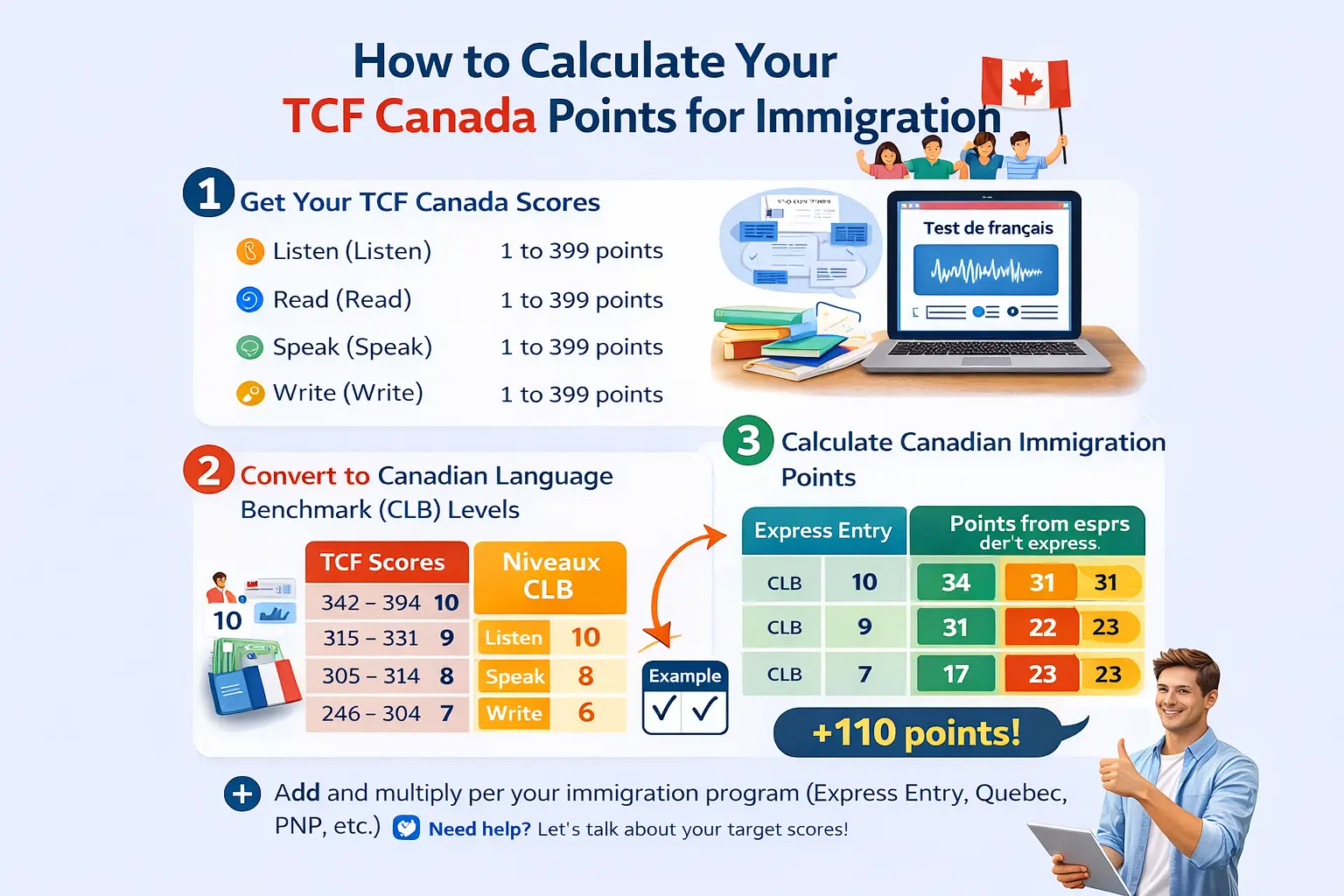
- Target minimum B2 level (CLB 7) in all four skills for 25 bonus points
- Ideally target C1 level (CLB 9) to maximize points across all CRS categories
- Practice with official TCF Canada materials and certified mock exams
- Weekly speaking practice with native speakers or qualified tutors
- Daily writing exercises with professional corrections
Phase 3 (Weeks 13-16): Examination and Results
- Book and complete official TCF Canada examination
- Await results (typically 2-4 weeks)
- Update Express Entry profile immediately upon receiving results
- If already strong in English, prove bilingualism for additional 50 points
- Target francophone category draws with 60-100 point lower cutoffs
Strategy BEFORE (Now Obsolete and Ineffective)
"I will first find employer in Canada, obtain job offer and LMIA, then create Express Entry profile with 50-200 bonus points."
Estimated time: 6-12 months
Cost: 1,000-3,000 CAD
Result: +50-200 points (NO LONGER VALID)
Success rate: N/A - strategy obsolete
Strategy AFTER (Recommended and Proven)
"I will first complete TCF Canada to obtain B2/C1 score, create profile with French points, and target francophone category draws."
Estimated time: 2-3 months
Cost: 300-500 CAD
Result: +25 to 75 points + access to targeted draws
Success rate: 70-85% for candidates reaching B2+ level
Strategy #2: Exploit Category-Based Draws Strategically
Since 2023, government organizes targeted draws for specific sectors experiencing labor shortages. These draws offer significantly reduced CRS cutoffs with detailed eligibility criteria:
| Draw Category | Typical CRS Cutoff | Concerned Professions (Examples) | Annual Draw Frequency | Strategy Recommendation |
|---|---|---|---|---|
| Healthcare | 420-450 points | Physicians, nurses, dentists, pharmacists, physiotherapists, medical lab technologists | 8-12 draws/year | Highly recommended - consistent demand |
| STEM | 430-460 points | Software developers, engineers, data scientists, analysts, researchers | 10-15 draws/year | Excellent option - broad eligibility |
| Trades | 410-445 points | Electricians, plumbers, carpenters, welders, mechanics, heavy equipment operators | 6-10 draws/year | Lower competition - great opportunity |
| Agriculture | 400-440 points | Agricultural supervisors, farm managers, specialized agricultural workers | 4-6 draws/year | Niche but accessible for qualified candidates |
| Transport | 405-435 points | Heavy truck drivers, pilots, aviation technicians, railway operators | 4-8 draws/year | Growing demand sector |
| Francophone | 430-465 points | All qualified occupations with French B2+ (CLB 7+) | 12-18 draws/year | MOST FREQUENT - highest invitation volume |
Combined Winning Strategy with Maximum Impact
If you are francophone AND work in targeted sector (for example, francophone nurse or francophone software developer), you double your invitation chances because you qualify for two different draw types simultaneously. This represents the most powerful strategy in 2025 Express Entry landscape!
Strategy #3: Increase Education Level with Canadian Credentials
Education provides substantial CRS points. If you have time and financial resources, consider these strategic options:
Education point values and strategic considerations:
- Canadian Master's degree (2-year program): +135 points for education + potential 3-year PGWP (Post-Graduation Work Permit) + Canadian experience accumulation
- Two or more credentials (one 3+ years): +128 points
- Doctoral degree: +150 points maximum + research opportunities + potential provincial nomination pathways
- Canadian vs foreign credentials: Canadian education provides additional points beyond foreign equivalent
Quadruple Advantage of Canadian Studies
Studying in Canada allows you not only to obtain education points, but also to:
- Obtain PGWP after studies (up to 3 years work permit depending on program length)
- Accumulate Canadian work experience during studies (part-time: 20h/week during semester, full-time during breaks) and post-graduation (up to 80 additional CRS points)
- Improve French/English in Canadian immersion context with authentic accent and cultural references
- Create professional network facilitating employment and integration post-graduation
- Access provincial nomination streams specifically for international graduates
- Develop Canadian references for future employment
Important note: Since June 2025, PGWP-eligible programs revised. Verify program eligibility before enrollment to ensure work permit eligibility upon graduation.
Strategy #4: Acquire Canadian Work Experience Through Multiple Pathways
Canadian work experience is among the most valued CRS factors and was not affected by 2025 reform—in fact, its relative value increased significantly.
| Canadian Experience Duration | CRS Points Awarded | Express Entry Category | Strategic Value |
|---|---|---|---|
| 1 year full-time (or equivalent part-time) | +40 points | Eligible for Canadian Experience Class (CEC) | Entry threshold for CEC pathway |
| 2 years | +53 points | CEC with increased priority | Optimal for most candidates |
| 3+ years | +64 points | CEC with maximum experience score | Maximum points, diminishing returns beyond 3 years |
How to obtain Canadian experience - comprehensive pathways:
- International Experience Canada (IEC) / Working Holiday: For youth 18-35 years (age varies by country), permits 1-2 years work in Canada. Available for 30+ countries with annual quotas.
- Temporary work permit with LMIA: Via job offer with LMIA (offer doesn't give CRS points anymore, but experience accumulated does!). Employer sponsors permit application.
- Open work permit (spouse of student/worker): If spouse studies or works in Canada with certain permit types. Allows unrestricted employment.
- PGWP after Canadian studies: As mentioned previously - 1-3 year work permit depending on program length
- Francophone mobility: LMIA exemption for certain positions if francophone working outside Quebec. Simplified work permit process.
- Intra-company transfer: If working for multinational with Canadian branch, potential transfer pathway
- CUSMA/USMCA (former NAFTA) provisions: For Mexican and American professionals in specified categories
Recommended "Bridge" Strategy for 2025-2026
Optimal pathway combining all advantages:
- Months 1-3: Complete TCF Canada and obtain B2/C1 level
- Month 3: Create Express Entry profile with French points
- Months 3-6: Simultaneously apply for IEC, study permit, or temporary work permit
- Months 6-30: Come to Canada and accumulate 1-2 years Canadian experience
- Month 18-30: Update profile with Canadian experience (+40-53 points)
- Month 24-36: Receive invitation via CEC or francophone draw with competitive CRS score
- Month 30-42: Complete permanent residence application and landing
This approach combines all advantages: French language, Canadian experience, targeted draw eligibility, and maximized CRS score through multiple contributing factors.
Conclusion: Adapt Your Strategy or Face Indefinite Waiting
Job offer CRS points elimination is not a catastrophe—it's a strategic reorientation of Canadian immigration system with clear policy intentions. Government sends unambiguous message: it prefers candidates who invest in competencies (language, education) or have genuine Canadian connection (experience, provincial nomination) rather than simply a job promise that may never materialize into actual long-term employment and integration.
Winners of This Reform
- Francophones: With targeted draws and bonus points, French mastery became #1 asset
- Workers in Canada: Canadian experience never more highly valued
- PNP candidates: Provincial programs become even more attractive
- Targeted sectoral profiles: Healthcare, STEM, trades benefit from dedicated draws with reduced cutoffs
- Bilingual candidates: French + English proficiency provides massive competitive advantage
Challenged by This Reform
- Candidates relying solely on job offer to compensate weak CRS score
- Non-francophone candidates without Canadian experience and without qualification in targeted sector
- "Average" profiles (400-430 points) not distinguished by any specific factor
- Older candidates (35+) with diminishing age points and no compensating factors
The key message: If you're not yet francophone, complete TCF Canada immediately. It's the most cost-effective investment you can make for your 2025 immigration. Few months of preparation can yield 25-75 CRS points and open access to targeted draws with 60-100 point lower cutoffs—transforming impossible timelines into realistic immigration pathways.
Don't remain waiting hoping for old system return. Adapt your strategy now, and you can transform this change into opportunity rather than obstacle.




 TCF Canada Hub
0 Comments
No comments
Be to the first to share your comment !