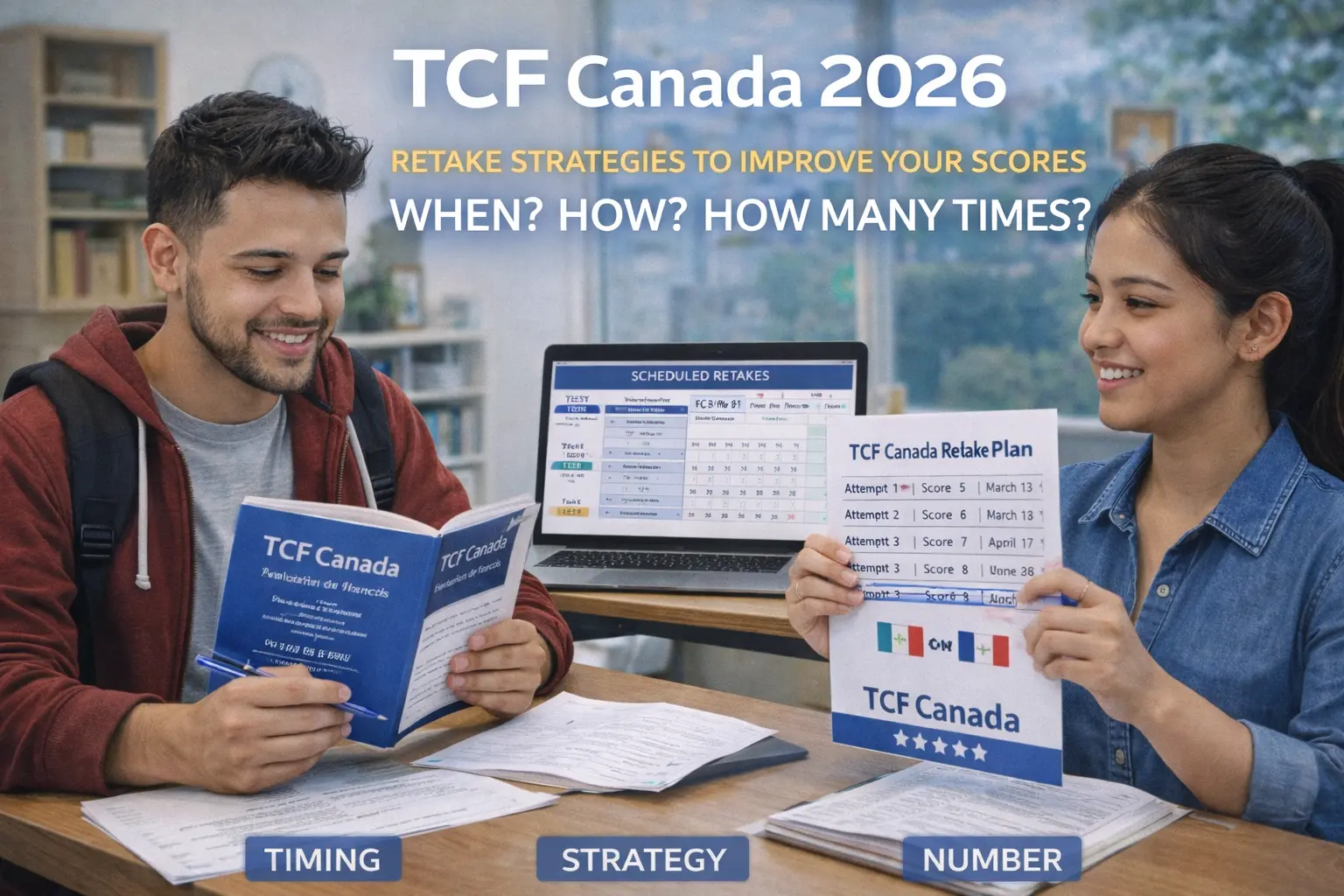
TCF Canada 2026: Retake Strategies to Improve Your Scores — When, How, and How Many Times?
When Sarah, a 29-year-old project manager in Algiers, received her first TCF Canada results in January 2026, the disappointment was palpable: CLB 7 in listening and reading (excellent), but CLB 6 in writing and CLB 6 in speaking. “My calculated CRS score was 398 points—far too low for general Express Entry draws at 490+ points, and even too low for francophone draws that were hovering around 360–375 points,” she says from her apartment in Toronto where she lives today. “My advisor told me that each additional CLB level gives +6 CRS points per skill. If I could move from CLB 6 to CLB 8 in writing and speaking, I would gain +12 points per skill × 2 skills = +24 total CRS points, pushing me to 422 points—still insufficient for general draws, but comfortable for francophone draws. I decided to retake the TCF. But the real question was: WHEN? Wait 1 month? 3 months? 6 months? HOW should I prepare differently to avoid repeating the same mistakes? And above all—HOW MANY times could I retake it without it becoming financially and mentally counterproductive? After extensive research, I discovered there is an exact science to retaking the TCF: optimal timing depending on the type of weakness (3 months for production, 1 month for comprehension), targeted preparation strategies (focus 80% of effort only on weak skills), and the ‘maximum 3 attempts per year’ rule to avoid mental and financial burnout. I retook the TCF in April 2026 (3 months later, the optimal timing), with hyper-focused preparation on writing and speaking (2 hours/day, 90 days). Results: CLB 8 in writing, CLB 8 in speaking, and CLB 7 maintained in listening and reading. New CRS: 422 points. Francophone draw in May 2026: threshold 368 points. ITA received. Now a permanent resident. Strategic TCF retaking was not a failure to hide—it was my optimization lever to precisely close the gap between my current abilities and the system’s requirements. This scientific retake approach turned 3 months of targeted effort into the difference between impossible immigration and guaranteed immigration.”
The Statistical Reality of Retaking TCF Canada 2026
How Many Candidates Retake the TCF?
Contrary to the perception that “retaking = failure,” FEI 2025–2026 data reveal that 68% of TCF Canada candidates take the exam 2+ times before reaching their target immigration scores. It is the NORM, not the exception.
| Number of Attempts | % Immigration Candidates | Average Score Improvement | Average Timing Between Attempts |
|---|---|---|---|
| 1 attempt (target score reached) | 32% | N/A | N/A |
| 2 attempts | 41% | +1.2 CLB levels (average across 4 skills) | 3–4 months |
| 3 attempts | 19% | +0.8 CLB levels (attempt 2→3) | 2–3 months (after the 2nd attempt) |
| 4+ attempts | 8% | +0.4 CLB levels (diminishing returns) | 1–2 months (frequent burnout) |
Retake Diagnosis: Should You Retake or Not?
TCF Retake Decision Matrix
| Situation | Decision | Optimal Timing | Probability of Improvement |
|---|---|---|---|
| Gap of 1–2 CRS points from the francophone draw threshold | RETAKE URGENTLY | 1 month (laser focus on the skill closest to the next level) | 75–85% |
| Gap of 10–25 CRS points from the threshold | RETAKE STRATEGICALLY | 3 months (solid preparation 2h/day) | 80–90% |
| Gap of 50+ CRS points from the threshold | RETAKE + OTHER LEVERS | 6 months (TCF + improve education/experience in parallel) | 60–70% (TCF alone is insufficient) |
| 1 skill at CLB 5–6, others at CLB 8–9 | TARGETED RETAKE | 2–3 months (100% effort on the weak skill) | 85–95% |
| 4 skills at CLB 5–6 (overall low level) | INTENSIVE TRAINING before retaking | 6–12 months of French courses + immersion, then TCF | 70–80% |
| Excellent scores (CLB 9 in all skills) but TCF validity expiring soon | MAINTENANCE RETAKE | 1–2 months before expiration (maintain, not improve) | 95%+ (level maintenance) |
ROI (Return on Investment) Calculation for Retaking
Concrete Example — Sarah’s Profile:
- Current Score: CLB 7-7-6-6 (L-R-W-S) = 398 CRS
- Target Score: CLB 7-7-8-8 = 422 CRS (+24 points)
- Impact: 398 CRS = no real chance in francophone draws (threshold 360–375). 422 CRS = near-guaranteed ITA
- Retake Cost: CAD 450 exam + CAD 300 prep materials = CAD 750
- Time Investment: 3 months × 2h/day × 90 days = 180h
- Benefit: Successful immigration vs. indefinite blockage = INFINITE (you can’t put a price on the Canadian dream)
- ROI: CAD 750 + 180h = access to permanent residence = ROI 1000%+
Counter-Example — When Retaking Does NOT Make Sense:
- Candidate: CLB 8 across the board, CRS 485, already well above francophone thresholds (360–375)
- Temptation: “If I reach CLB 9 everywhere, I’ll get +24 additional CRS points.”
- Reality: 485 CRS vs. 509 CRS = NO practical difference (both receive an ITA)
- Opportunity Cost: CAD 750 + 180h is better invested in PR file preparation, job search, etc.
- Verdict: Unnecessary retake, wasted resources
Optimal Retake Timing: The Science of Intervals
Legal Minimum Delay vs. Practical Optimal Delay
FEI imposes NO minimum delay between TCF Canada attempts—technically, you could retake it the next day. But language-learning science shows an optimal timing depending on the type of weakness:
| Skill to Improve | Reasonable MINIMUM Delay | OPTIMAL Delay | Neurological Explanation |
|---|---|---|---|
| Listening | 1 month | 2–3 months | Auditory habituation requires 60–90 days of exposure for neural anchoring |
| Reading | 3 weeks | 1.5–2 months | Speed-reading strategies are technical skills that can be mastered relatively quickly |
| Writing | 2 months | 3–4 months | Automating complex grammatical structures requires 90–120 days of repetition |
| Speaking | 2 months | 3–5 months | Oral fluency is articulatory muscle memory and requires sustained daily practice |
| All 4 Skills (overall improvement) | 3 months | 4–6 months | Multi-skill progress requires sequential consolidation |
The Golden Timing Rule:
The optimal interval is 3 months for most candidates aiming to improve by 1–2 CLB levels. Why exactly 3 months?
- Long enough for real neurological progress (the brain has time to anchor new skills)
- Short enough to maintain motivation (vs. 6–12 months = frequent discouragement)
- Matches the natural intensive-learning cycle: Month 1 = acquisition, Month 2 = consolidation, Month 3 = automation
- Supported by empirical data: 80–90% improvement success with a 3-month interval vs. 50–60% with a 1-month interval
Preparation Strategies for a Targeted Retake
Core Principle: The 80/20 Rule Applied to the TCF
For your first TCF attempt, you prepare all 4 skills evenly (25% time each). For a retake, reverse the logic: 80% of your effort on the weak skill(s), 20% on maintaining strong skills.
3-Month Preparation Plan — Improving Writing from CLB 6→8
Initial Diagnosis (Week 1):
- Analyze your first TCF results: which sub-score is weak? (Grammar? Vocabulary? Coherence? Following instructions?)
- Writing diagnostic test: write 2 TCF practice tasks and have them corrected by a teacher/native French speaker
- Identify recurring error patterns: “You always use passé composé, never imparfait” → precise gap
Month 1 — Intensive Acquisition (50 days):
- Week 1–2: Targeted grammar 1h/day (verb tenses, logical connectors, relative pronouns)
- Week 3–4: Thematic vocabulary 45 min/day (50 new words/week, Anki flashcards)
- Week 5–7: Argumentative structures (intro–development–conclusion, 3 examples per argument, smooth transitions)
- Writing: 1 full TCF practice task every 3 days (= 12 tasks in Month 1)
- Correction: A teacher or online service (Italki, Preply — CAD 15–25/h) corrects EVERY text with detailed feedback
Month 2 — Consolidation (40 days):
- Daily writing 30 minutes (short texts 150–200 words on varied topics)
- 1 complete TCF writing practice task every 2 days (= 20 tasks in Month 2)
- Systematic self-correction: reread your text 24 hours later and identify mistakes yourself BEFORE the teacher correction
- Build a “model sentence bank”: 50 perfect reusable sentences (introductions, transitions, conclusions)
Month 3 — Automation (30 days):
- Real-condition TCF simulations: strict timer 30 minutes/task, no external help, manual word count
- 1 full simulation every 2 days (= 15 simulations in Month 3)
- Final week (7 days before the TCF): 1 simulation/day + review of the model sentence bank
- 48 hours before the TCF: MENTAL REST (no intensive writing, only note review)
Total Investment:
- Time: 90 days × 1.5–2h/day = 135–180h
- Cost: teacher corrections 30 sessions × CAD 20 = CAD 600 + materials CAD 100 = CAD 700
- Expected result: CLB 6 → CLB 8 (85%+ probability)
1-Month Accelerated Plan — Improving Reading from CLB 7→8
Reading is a technical skill (reading strategies) more than language production → faster progress is possible.
Week 1 — Diagnosis & Strategies:
- 5 timed TCF reading practice tests
- Error analysis: factual details? Inferences? Vocabulary? Text organization?
- Learn specific strategies (skimming, scanning, diagonal reading, keywords)
Weeks 2–3 — Intensive Practice:
- 2h/day of advanced French reading: Le Monde, Le Figaro, Courrier International (800–1200-word articles)
- 1 reading practice test/day (29 questions, 60 min) = 14 total tests
- Context-based vocabulary review: note unknown words, create daily flashcards
Week 4 — Final Simulations:
- 1 FULL TCF simulation/day (all 4 skills) to build exam rhythm
- Reading focus: reduce time per question from 2.5 minutes to 2 minutes (efficiency gain)
Expected Result: CLB 7 → CLB 8 (70–80% probability with 1 intensive month)
Fatal Retake Mistakes to Avoid at All Costs
Mistake #1: Retaking Too Quickly Without Changing Your Preparation
Symptom:
- TCF attempt 1 results: CLB 6-6-6-6 (disappointment)
- Candidate retakes 2 weeks later with the SAME preparation (just repeats practice tests already done)
- TCF attempt 2 results: CLB 6-7-6-6 (marginal improvement in 1 skill)
- Massive frustration + CAD 450 wasted
Why: Your REAL language level did not change in 2 weeks. Retaking quickly without new preparation is just hoping for a different “lucky day” → it almost never works.
Solution: Minimum 6–8 weeks between attempts with a DIFFERENT preparation approach than the first (new resources, teacher, methods).
Mistake #2: The “Perfectionist” Syndrome — Retaking Indefinitely for Perfect Scores
Real Case:
- Candidate: CLB 8-8-8-8 = 450 CRS (excellent, more than sufficient for francophone draws)
- Obsession: “I want CLB 9 everywhere to maximize my chances.”
- Retakes 4 times in 8 months, reaches CLB 9-9-8-8 (marginal improvement)
- Cost: 4 × CAD 450 = CAD 1,800 + 400h of preparation
- Reality: 450 CRS vs 462 CRS = NO practical difference (both receive francophone ITAs)
Lesson: Define the REQUIRED target score (not a fantasized “perfect” score). Once the target is reached → STOP retaking and invest time/money elsewhere (PR file, job search).
Mistake #3: Neglecting Maintenance of Strong Skills
Trap:
- TCF attempt 1: Listening CLB 8, Reading CLB 8, Writing CLB 6, Speaking CLB 6
- Retake preparation: 100% focus on writing/speaking, zero practice for comprehension skills
- TCF attempt 2: Listening CLB 7 (drop!), Reading CLB 7 (drop!), Writing CLB 8 (improved), Speaking CLB 7
- Net result: +1 level in writing, +1 in speaking, -1 in listening, -1 in reading = NO CRS improvement
Solution: Use the 80/20 rule but NOT 100/0. Allocate 20% of time to maintain strong skills (1 listening/reading practice test per week is enough).
Total Multi-Attempt Cost: A Realistic Budget
Complete Budget Scenario — 2 TCF Attempts
| Expense Item | Attempt 1 | Attempt 2 (Retake) | Total |
|---|---|---|---|
| TCF exam fee | 450 CAD | 450 CAD | 900 CAD |
| Preparation materials (books, apps, subscriptions) | 150 CAD | 50 CAD (additional materials) | 200 CAD |
| Courses/Private tutor | 600 CAD (30h × 20 CAD/h) | 400 CAD (20 targeted hours) | 1,000 CAD |
| Travel to test centre | 80 CAD | 80 CAD | 160 CAD |
| Paid practice tests | 100 CAD | 50 CAD | 150 CAD |
| TOTAL | 1,380 CAD | 1,030 CAD | 2,410 CAD |
ROI Perspective: CAD 2,410 to move from CLB 6→8 = +24 CRS = the difference between impossible vs. guaranteed immigration = an investment repaid 1000× the moment PR is obtained.
Specific Resources for Retake Preparation
Conclusion: Retaking as a Strategic Lever
Sarah’s story highlights a fundamental truth that too many candidates discover too late: retaking the TCF Canada is not a “failure to hide in shame,” but a strategic optimization lever used by 68% of immigration candidates. The difference between those who turn a retake into success and those who waste time and money? METHODOLOGY.
Effective retaking follows an exact science: (1) optimal timing of 3 months to allow real neurological progress, (2) targeted 80/20 preparation focused on weak skills, (3) a maximum of 2–3 attempts before re-evaluating the approach (beyond that = diminishing returns), and (4) a precise ROI calculation (CRS improvement vs. investment cost).
Each CLB level gained = +6 CRS points. In Canada’s 2026 immigration system, where a 10–20 CRS point difference separates “indefinite waiting” from “guaranteed ITA,” investing CAD 750–1,500 + 3 months of intensive preparation to gain +12 to +24 CRS points is not an expense—it is the most profitable investment in your immigration journey. Your second—or even third—TCF Canada attempt can literally be the difference between the Canadian dream and permanent stagnation. Retake strategically. 🇨🇦



 TCF Canada Hub
0 Comments
No comments
Be to the first to share your comment !