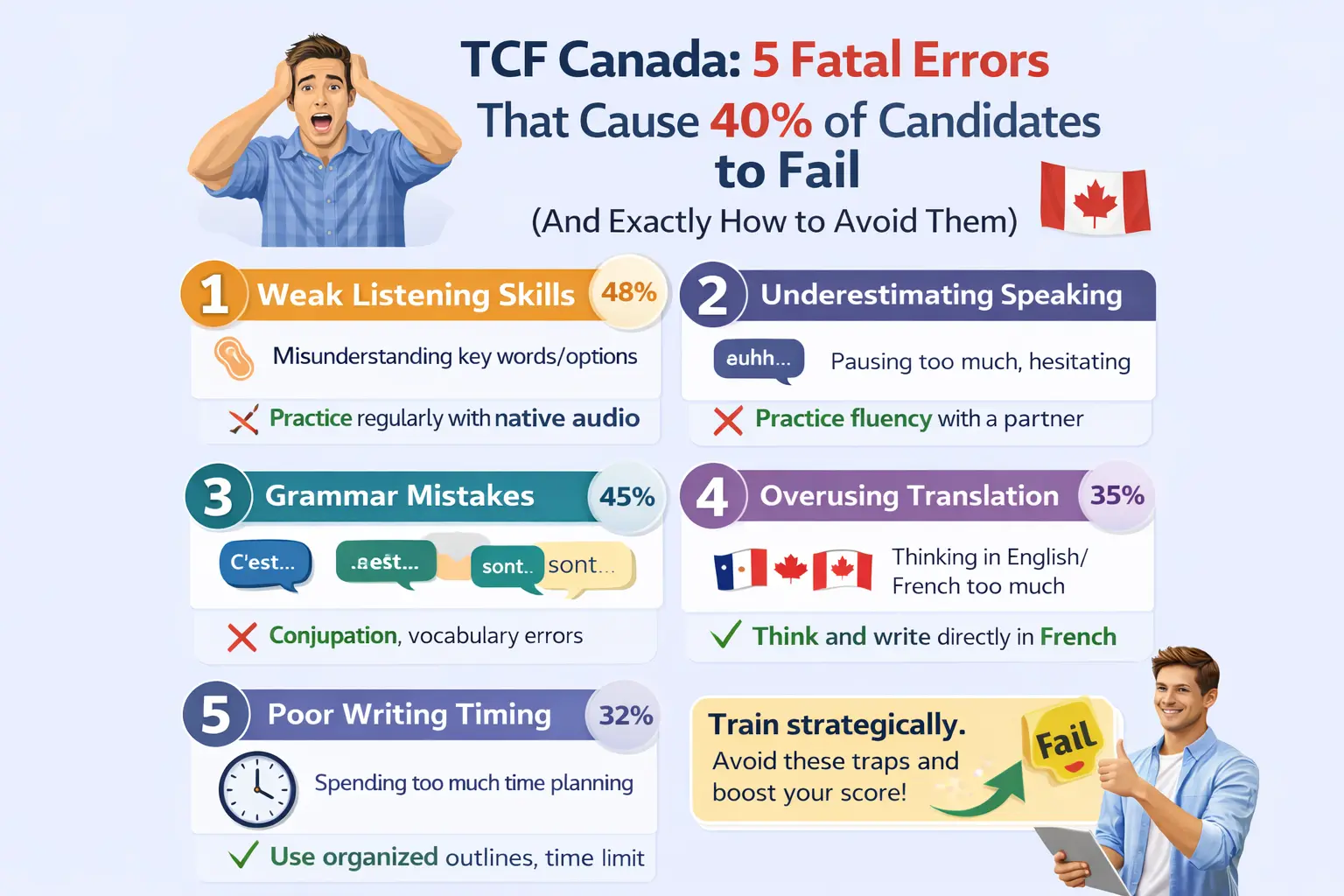
TCF Canada: 5 Fatal Errors That Cause 40% of Candidates to Fail (And Exactly How to Avoid Them)
Every year, thousands of candidates take TCF Canada hoping to obtain the score that will transform their lives and open doors to Canadian permanent residence. Unfortunately, nearly 40% fail to reach the B2 level necessary to maximize their CRS points, and many fail particularly at the speaking expression section, derailing carefully planned immigration timelines and costing both money and months of delay.
The good news? These failures are not due to lack of talent or French competence. They are almost always caused by completely avoidable errors that I will reveal comprehensively in this in-depth analysis and strategic guide.
Alarming Statistics from France Éducation International
40% of candidates obtain scores below B2 in speaking expression, but those who train with authentic simulations see average score increases of 15-20% and dramatically improved success rates.
Source: France Éducation International (formerly CIEP), comprehensive study 2022-2024 analyzing 50,000+ candidate results
After analyzing hundreds of candidate testimonials, studying official reports from France Éducation International, and consulting with TCF preparation experts, I have identified the 5 fatal errors that sabotage results for the majority of candidates. More importantly, I will show you exactly how to avoid them systematically to maximize your score and achieve the B2/C1 levels that make decisive differences in Express Entry CRS calculations.
Fatal Error #1: Dramatically Underestimating Necessary Preparation Time
The Trap: "I already speak French well, I can take the test in 2 weeks"
This is by far the most expensive and common error. Many native francophone candidates or those with good French level think they can pass TCF Canada without specific preparation. Serious mistake with severe consequences.
Why this is critically problematic:
- TCF Canada doesn't simply evaluate your French mastery, but your capacity to respond to very specific exercise formats with unique timing constraints and evaluation criteria
- Each section has its own time constraints and evaluation criteria requiring familiarization and strategy development
- Even with excellent French, you can lose precious points through lack of examination strategy and format awareness
- Stress management on test day can dramatically reduce performance without proper mental preparation
- Cultural and contextual knowledge: Canadian French expressions, Quebec accent familiarity, cultural references in materials
- Technical requirements: Computer-based testing interface, headset use, typing speed for written expression
Real Candidate Example: Karim's Experience
Background: Grew up in francophone family in Morocco, spoke fluent French daily, university education in French
Preparation: Only 2 weeks before exam, minimal format familiarization
Result: B1 in written expression (due to unfamiliar format requirements), B1 in speaking expression (panicked during examiner interaction)
Outcome: Had to retake test 2 months later after proper preparation
Second attempt result: C1 in all four sections after structured 8-week preparation
Cost of underpreparation: Additional 300€ exam fee + 2 months immigration timeline delay + stress and disappointment
The Solution: Plan Structured 8-12 Week Preparation with Detailed Timeline
Expert-recommended preparation plan with weekly objectives:
| Weeks | Preparation Focus | Specific Objectives | Time Investment | Key Activities |
|---|---|---|---|---|
| 1-2 | Format familiarization | Understand each section structure, complete diagnostic test | 8-10 hours/week | Official materials review, diagnostic assessment, weakness identification |
| 3-5 | Weakness reinforcement | Intensively work on identified weak points | 10-12 hours/week | Targeted exercises, vocabulary building, grammar review for weak areas |
| 6-8 | Real conditions training | Complete timed mock tests, speaking simulations | 12-15 hours/week | Full practice tests weekly, recorded speaking practice, timed writing |
| 9-10 | Refinement and strategies | Perfect techniques, review common errors | 10-12 hours/week | Error pattern analysis, strategy optimization, weak section focus |
| 11-12 | Consolidation and stress management | Final simulations, relaxation techniques, positive visualization | 8-10 hours/week | Final mock exams, mental preparation, confidence building, logistics planning |
Essential Preparation Checklist
- Read official TCF Canada documentation on France Éducation International website thoroughly
- Complete minimum 5 full mock tests under real conditions (strict timing, no pauses)
- Practice speaking expression with partner or qualified tutor minimum 3 times weekly
- Write minimum 20 written expression texts and obtain professional corrections with feedback
- Listen to Canadian francophone content (Radio-Canada, Quebec podcasts, Canadian media) daily for accent and cultural familiarization
- Review thematic vocabulary comprehensively (health, environment, technology, society, economics, education)
- Familiarize with computer-based testing interface if available
- Practice typing in French to improve written expression speed and efficiency
Fatal Error #2: Neglecting Speaking Expression (The Section That Fails Most Candidates)
The Trap: "I speak French every day, speaking will be easy"
Speaking expression is systematically the section where candidates obtain lowest scores. According to official statistics, 40% of candidates fail to reach B2 level in this section, while many succeed better in other parts—creating devastating CRS point gaps.
Why speaking expression is exceptionally difficult:
- Direct interaction stress: Face-to-face with examiner who observes and evaluates in real-time
- No preparation time for certain tasks: Immediate response required for some questions
- Strict evaluation criteria: Grammar, vocabulary, pronunciation, fluency, coherence—all simultaneously assessed
- Expected structures: Not sufficient to simply "speak"—must follow precise argumentative structures
- Limited time management: Each task has precise time limit (1 to 4 minutes depending on task)
- Recording pressure: Awareness of being recorded can increase anxiety
- Examiner variability: Different examiner styles and interaction patterns
The Solution: Regular Speaking Practice with Authentic Simulations
TCF Canada Speaking Expression Structure Detailed
| Task | Format | Duration | Target Level | Evaluation Focus |
|---|---|---|---|---|
| Task 1 | Guided interview (personal questions) | 2 min | A2-B1 | Basic fluency, comprehensible responses, basic vocabulary |
| Task 2 | Interactive exercise (role-play scenario) | 3-4 min | B1-B2 | Argumentation, persuasion, appropriate register, interaction skills |
| Task 3 | Point of view expression (argumentation on topic) | 4-5 min | B2-C1 | Complex argumentation, vocabulary richness, coherent structure, nuanced opinion |
Concrete Strategies for Each Task with Examples
Task 1 Strategy: Personal Questions (2 minutes)
Poor approach example:
"Uh, I'm 28 years old. I work. I like reading. That's all."
Problems: Too brief (15 seconds), minimal vocabulary, no development, poor fluency
Excellent approach example:
"I'm 28 years old and currently work as software engineer in Casablanca. In my free time, I particularly enjoy reading contemporary French literature—authors like Leïla Slimani fascinate me with their psychological depth and social commentary. This hobby helps me maintain my French language skills while discovering francophone cultural perspectives."
Strengths: Appropriate length (35-40 seconds), specific vocabulary, natural development, cultural reference
Task 2 Strategy: Role-Play (3-4 minutes)
Poor approach: Improvising without structure, forgetting polite formulas, weak argumentation
Excellent approach structure:
- Opening (15-20 seconds): Polite greeting, state purpose clearly
- Problem presentation (30-45 seconds): Explain situation with specific details
- Argumentation (60-90 seconds): Present 2-3 clear arguments with examples
- Request (20-30 seconds): State clearly what you want/need
- Closing (15-20 seconds): Polite closing, thanks, anticipation of response
Task 3 Strategy: Opinion Expression (4-5 minutes)
Required structure for B2/C1 level:
- Introduction (30-40 seconds): "This topic raises the question of... Opinions vary considerably. In my view..."
- Thesis statement (15-20 seconds): Clear position with nuance
- Argument 1 (60-75 seconds): "Firstly... For example... Thus..."
- Argument 2 (60-75 seconds): "Moreover... This is illustrated by... Consequently..."
- Counter-argument acknowledgment (30-40 seconds): "While some argue... however..."
- Conclusion (30-40 seconds): "In conclusion... It would be beneficial to..."
Fatal Error #3: Poor Time Management During Sections
The Trap: "I'll take my time and think carefully about each question"
TCF Canada is a marathon against the clock. Many highly competent candidates lose precious points simply because they didn't complete a section or spent excessive time on difficult questions at expense of easier ones.
The Solution: Master Time Management Strategies for Each Section
Optimal Time Distribution by Section
Reading Comprehension (60 minutes - 39 questions)
Strategic time allocation:
- Initial rapid reading (skimming): 30-45 seconds per text for general understanding
- Answer easy questions first: A1-A2 level questions priority (first 5-10 questions) - complete these in 15-20 minutes total
- Maximum time per question: Never exceed 2 minutes on single question
- Mark difficult questions: Skip and return if time remains at end
- Keep 5 final minutes: Verify responses and complete pending questions
- Questions 30-39 strategy: These complex questions require 2.5-3 minutes each - allocate 25-30 minutes total
Listening Comprehension (35 minutes - 39 questions)
Critical timing strategies:
- Read question BEFORE audio: Use 10-15 second pause to understand what's requested
- Take targeted notes: Only keywords during listening (numbers, names, action verbs, dates)
- Respond immediately after audio: Don't overthink - first impression often correct
- Don't block on missed question: If you missed audio content, check random answer and move forward
- No review opportunity: Unlike reading, cannot return to previous questions
Written Expression (60 minutes - 3 tasks)
| Task | Recommended Time | Word Count | Strategy | Key Focus |
|---|---|---|---|---|
| Task 1 | 12-15 minutes | 60-80 words | Simple direct message, standard polite formulas | Clarity, appropriate register |
| Task 2 | 18-20 minutes | 120-150 words | Clear structure with 2-3 paragraphs, varied vocabulary | Formal register, coherent organization |
| Task 3 | 22-25 minutes | 180-200 words | Structured argumentation (intro-development-conclusion) | Complex arguments, rich vocabulary, logical connectors |
| Final proofreading: 5 minutes to correct spelling and grammar errors | ||||
Fatal Error #4: Neglecting Comprehension Sections (Listening and Reading)
The Trap: "I'll focus on expression sections, comprehension is easier"
Many candidates assume comprehension sections (listening and reading) are automatically simpler because they're multiple choice. Major strategic error with severe consequences.
Why comprehension is critically important:
- Comprehension represents 50% of total TCF Canada score (78 questions of 156 total)
- CRS system calculates points based on your weakest competency—poor comprehension score cancels excellent expression score
- Questions become progressively more difficult with subtle linguistic traps
- Statistically, candidates with minimum B2 in both comprehensions have 40% higher overall success probability
- Listening comprehension challenges: Canadian accent, Quebec expressions, audio quality variations, single listening opportunity
- Reading comprehension challenges: Complex texts, nuanced language, time pressure, vocabulary breadth required
The Solution: Methodical Training for Both Comprehension Types
Listening Comprehension Strategies
Common traps to avoid:
| What Failing Candidates Do ❌ | What Successful Candidates Do ✅ |
|---|---|
| Try to understand every single word | Focus on main ideas and key information |
| Panic if they don't understand a word | Accept not understanding everything, continue listening |
| Don't anticipate information type requested | Read question first, anticipate what to listen for |
| Take no notes whatsoever | Note keywords strategically (numbers, names, dates, actions) |
| Concentrate on details instead of general idea | Grasp overall message, then identify specific details |
| Get stuck on one difficult audio | Move on quickly, guess if necessary |
Reading Comprehension Strategies
Text types and adapted strategies:
| Text Type | Level | Reading Strategy | Time Allocation |
|---|---|---|---|
| Short messages, emails, announcements | A1-A2 | Rapid reading, identify factual information (who, what, where, when) | 45-60 sec/question |
| Press articles, blogs, informational texts | B1-B2 | Identify main idea of each paragraph, attention to opinions vs facts | 1.5-2 min/question |
| Argumentative texts, reviews, complex analysis | B2-C1 | Analyze argumentative structure, distinguish facts and opinions, identify nuances | 2-2.5 min/question |
Fatal Error #5: Not Analyzing Errors and Not Adjusting Preparation
The Trap: "I do practice tests but never examine my errors in detail"
This is the most insidious error because it creates illusion of progress without real improvement. Many candidates accumulate practice tests but continue making identical errors repeatedly.
Why this is counterproductive:
- You repeat same errors without understanding why you're wrong
- You don't develop strategies to avoid these errors
- You waste limited practice test resources without learning
- You arrive on test day with same weaknesses as beginning
- Pattern blindness: Without analysis, you can't identify recurring error patterns
- Strategic gaps: Missing opportunities to develop test-taking strategies
Real Candidate Example: Sophie's Learning Experience
Initial approach: Completed 15 practice tests before exam, thought she was ready
Problem: Never truly analyzed why she made errors
Result: On test day, repeated exact same types of errors as at beginning
Outcome after failure: Understood that simply practicing wasn't enough—needed to practice INTELLIGENTLY with systematic error analysis
Second attempt strategy: Completed only 8 practice tests but spent equal time analyzing every error in detail
Second attempt result: Improved from B1 to C1 average across all sections
The Solution: Adopt Analytical and Iterative Approach
Error Analysis Method (Complete After EVERY Practice Test)
5-step analysis process:
- Step 1 - Identify: List all errors by section and question type in systematic spreadsheet
- Step 2 - Categorize: Classify errors (vocabulary comprehension? Time management? Misinterpretation? Linguistic trap? Format unfamiliarity?)
- Step 3 - Understand: For each error, write WHY you were wrong and what correct logic should have been
- Step 4 - Create flashcard: Note error type and strategy to avoid it in future
- Step 5 - Target: Create specific exercises to work on identified weak points
Concrete Error Analysis Example
Error Analysis Card - Listening Comprehension, Question 12
Error made: Chose answer B, correct answer was C
Why I was wrong: Focused on word "possible" in audio and associated it with answer B containing "possibilité." But audio actually said it was NOT possible.
Error type: Negation trap - missed "ne...pas" construction
Strategy to avoid: Always pay extreme attention to negations (ne...pas, ne...plus, ne...jamais, etc.). Mentally highlight these words.
Reinforcement exercise: Complete 10 specific exercises on negative sentence structures
Progress Tracking Table
Create Excel or Google Sheets to track evolution:
| Date | Test | LC | RC | WE | SE | Overall | Identified Weaknesses | Improvement Actions |
|---|---|---|---|---|---|---|---|---|
| Sept 15 | Diagnostic | 380 | 410 | 350 | 340 | B1 | Speaking (structure), precise vocabulary | Daily speaking practice, vocabulary lists |
| Sept 29 | Mock 1 | 420 | 450 | 390 | 380 | B2 | Written expression time management | Timed writing exercises, templates |
| Oct 13 | Mock 2 | 460 | 480 | 430 | 420 | B2+ | Listening C1 level (questions 35-39) | Advanced listening materials, Canadian media |
| Oct 27 | Mock 3 | 490 | 510 | 480 | 470 | C1 | Consolidation - ready for exam! | Maintain routine, confidence building |
Conclusion: TCF Canada Success is About Method, Not Just Talent
After reading this comprehensive analysis, you now understand why so many candidates fail TCF Canada—and critically, how to ensure you're not part of that 40%.
Recap of 5 Fatal Errors to Avoid
- Underestimating preparation time → Plan 8-12 weeks structured preparation
- Neglecting speaking expression → Practice with regular simulations and feedback
- Poor time management → ALWAYS train with chronometer
- Neglecting comprehension → 50% of score, specific strategies for listening and reading
- Not analyzing errors → Systematic analysis process after every practice test
The good news? All these errors are completely avoidable with proper method and structured preparation. Candidates who succeed on first attempt aren't necessarily most gifted in French—they're those who prepared most intelligently and systematically.
Your TCF Canada score can be the decisive factor transforming your immigration project from dream to reality. Don't leave it to chance. Avoid these 5 fatal errors, follow strategies shared in this guide, and you'll maximize your chances of reaching B2/C1 level that makes all the difference in Express Entry CRS calculations and Canadian permanent residence pathways.
You now have all keys in hand. The question isn't "CAN I succeed at TCF Canada?" but "WILL I apply these strategies to succeed?"
Begin your structured preparation today. Your Canadian permanent residence depends on it.





 TCF Canada Hub
0 Comments
No comments
Be to the first to share your comment !