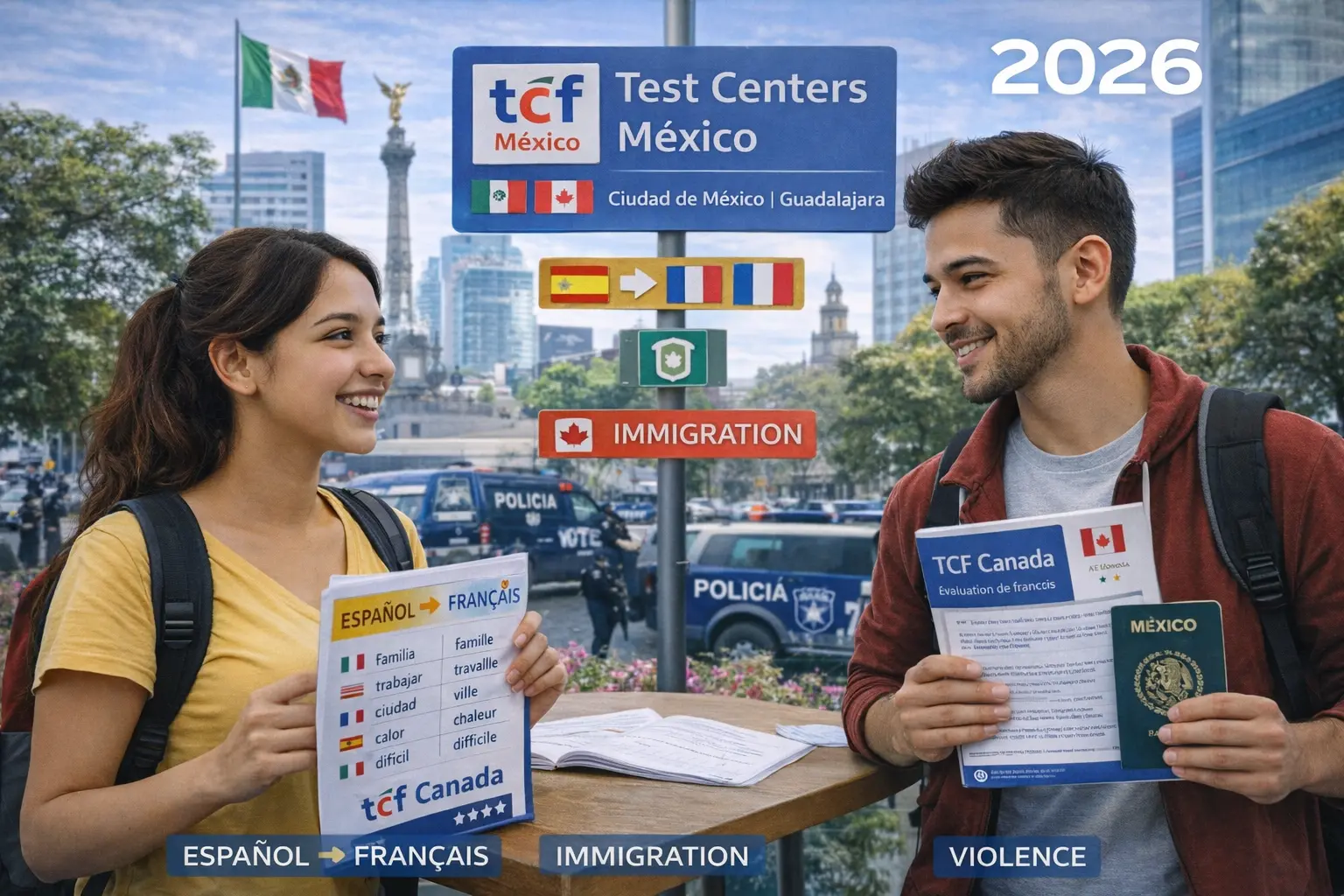
TCF Canada in Mexico 2026: Mexico City/Guadalajara Test Centres, Spanish→French Strategy, Immigration as Refuge from Violence and Gateway to Economic Opportunity
When Carlos, a 33-year-old architect in Mexico City (salary 35,000 MXN/month ≈ €1,730 ≈ $1,850 USD), decided to immigrate to Canada in 2024 to escape chronic violence (Mexico City homicide rate 27/100,000 vs. Canada 2/100,000), his first reaction was: "English IELTS is obvious—I already work in English at a B2 level." After calculating his CRS score (418 points = insufficient for general Express Entry draws at 485+), he discovered the francophone strategy by chance on LinkedIn. "Eighteen months of intensive French learning (Alliance Française Mexico classes 3×/week, 6h + daily French media immersion 2h) = TCF Canada CLB 7-7-8-7 in March 2026. New CRS: 392 points BUT eligible for francophone draws with thresholds of 365–380 = ITA (Invitation to Apply) obtained in May 2026 with a +12-point margin. Total investment: 18 months + 79,500 MXN (€3,925 ≈ $4,200 USD) = successful immigration versus indefinite blockage through the anglophone route. Arrival in Toronto in August 2026, architect position at Canadian firm Williamson Williamson Architects (sustainable design specialization), salary CAD 85,000 (€72,000 ≈ $61,000 USD) vs. 35,000 MXN in Mexico (€1,730) = salary increase ×41 in real purchasing power. But more important than money: SAFETY. My children can now play outside, go to school without fear of kidnapping, extortion, or drug-related violence. My wife goes out at night without anxiety. We no longer calculate 'security costs' into our monthly budget—no more private security, armored cars, or avoiding entire neighborhoods. The cost of living in Canada versus the cost of daily survival in Mexico is incomparable," he explains from his suburban home in Mississauga, Ontario (4-bedroom house CAD 720,000 vs. equivalent safe-area Mexico City housing at 12M MXN ≈ €590,000—financially unattainable for 98% of Mexican professionals). This comprehensive guide explores Mexican test centres, the Spanish→French linguistic challenge (similar to Spain but with radically different motivations—survival and opportunity, not just lifestyle), typical Mexican immigrant profiles (Guadalajara IT professionals, CDMX corporate refugees, families fleeing violence), and detailed ROI calculations for the francophone strategy that bypasses massive anglophone competition while opening doors to safety, prosperity, and peace of mind.
The Mexican Immigration Crisis: Why Thousands Are Choosing the French-Canadian Route (2024-2026 Data)
The Harsh Reality Driving Mexican Immigration to Canada
Why Mexican Professionals Choose Canada Over USA (Shifting Trends 2024-2026)
| Factor | USA Immigration | Canada Immigration (French Strategy) |
|---|---|---|
| Processing Time | H1B lottery (8-15 years for Green Card), EB-2/EB-3 backlogs 5-10 years | Express Entry francophone: 6-12 months from ITA to PR |
| Success Probability | H1B lottery: 26% approval rate (2024), dependent on employer sponsorship | French strategy CRS 370-380: 85-95% ITA probability within 6 months |
| Pathway Certainty | Employer-dependent, visa uncertainties, political volatility | Points-based, transparent, independent of employer |
| Healthcare | Employer-dependent, out-of-pocket costs $5,000-15,000/year for families | Universal healthcare, $0 out-of-pocket for most services |
| Initial Investment | $8,000-15,000 (visa fees, lawyer, applications) | $4,200-6,500 (French learning + TCF + immigration fees) |
| Anti-immigrant Climate | Increasing hostility, policy uncertainty, deportation fears | Welcoming immigration policies, multiculturalism celebrated |
Profile of Mexican Immigrants Choosing the French-Canadian Route
Three Dominant Mexican Immigrant Archetypes (2024-2026):
1. The Guadalajara Tech Professional (Age 28-38, IT/Software)
- Profile: Software engineer, data scientist, UX designer in Guadalajara's Silicon Valley (Zapopan tech corridor)
- Mexican salary: 40,000-70,000 MXN/month ($2,150-3,750 USD)
- Canadian salary potential: CAD 75,000-120,000 ($54,000-86,000 USD)
- Primary motivation: 60% economic opportunity, 40% security concerns
- Typical timeline: 15-18 months French learning → TCF CLB 7-8 → ITA within 3-6 months
- Advantage: Already fluent in English (works with US clients), adding French = trilingual competitive edge
2. The Mexico City Corporate Refugee (Age 32-45, Families with Children)
- Profile: Mid-senior professionals (finance, consulting, engineering, healthcare) in CDMX, married with 1-3 children
- Mexican salary: 50,000-90,000 MXN/month ($2,700-4,800 USD) — upper-middle class
- Canadian salary potential: CAD 70,000-110,000 ($50,000-79,000 USD)
- Primary motivation: 75% safety for children, 25% quality of life (healthcare, education, rule of law)
- Typical concern: "We earn well in Mexico but live in constant fear. Our children's school has armed guards. We can't go to parks. We've been robbed twice. Money doesn't matter if you can't sleep at night."
- Typical timeline: 18-24 months (family coordination, slower French learning pace due to work/children)
3. The Monterrey Industrial Engineer (Age 29-40, Manufacturing/Automotive)
- Profile: Mechanical, industrial, or electrical engineer in Monterrey's manufacturing sector (automotive, aerospace)
- Mexican salary: 45,000-75,000 MXN/month ($2,400-4,000 USD)
- Canadian salary potential: CAD 75,000-95,000 ($54,000-68,000 USD)
- Primary motivation: 50% economic, 50% security (Monterrey cartel violence escalation 2022-2024)
- Advantage: Canadian manufacturing hubs (Ontario, Quebec) actively recruiting engineers with Mexico manufacturing experience
- Typical timeline: 16-20 months French learning + credential evaluation
TCF Canada Test Centres in Mexico 2026: Complete Infrastructure Guide
Major Test Centers with Detailed Information
| City | Centre | Session Frequency | Fee MXN (USD) | Booking Lead Time | Notes |
|---|---|---|---|---|---|
| Mexico City (CDMX) | Alliance Française Mexico (Polanco) | 4–6 sessions/month | 8,500 MXN ($455 USD) | 2-3 weeks | Largest centre, easiest booking, Saturday/weekday options |
| Mexico City | IFAL (French Institute of Latin America) | 3–4 sessions/month | 8,500 MXN ($455 USD) | 3-4 weeks | Official cultural centre, primarily Saturday sessions |
| Guadalajara | Alliance Française Guadalajara | 2 sessions/month | 8,500 MXN ($455 USD) | 4-6 weeks | Tech hub, IT professional clientele, book early |
| Monterrey | Alliance Française Monterrey | 2 sessions/month | 8,500 MXN ($455 USD) | 4-5 weeks | Industrial city, engineering profiles dominant |
| Puebla | Alliance Française Puebla | 1–2 sessions/month | 8,500 MXN ($455 USD) | 6-8 weeks | Advance booking critical, limited capacity |
| Querétaro | Alliance Française Querétaro | 1 session/month | 8,500 MXN ($455 USD) | 6-10 weeks | Growing aerospace/automotive hub, increasing demand |
| Cancún | Alliance Française Cancún | 1 session/month | 9,000 MXN ($480 USD) | 4-6 weeks | Tourism/hospitality profiles, international clientele |
| Mérida | Alliance Française Mérida | 1 session/month | 8,500 MXN ($455 USD) | 5-7 weeks | Quieter city, growing expat/remote worker population |
Official Resources:
- Alliance Française Mexico – National Network
- IFAL Mexico – French Institute of Latin America
- TCF Canada Official Site (France Éducation International)
Test Day Logistics in Mexico
What to Expect on Test Day (Mexico-Specific Considerations):
Documentation Required:
- Valid passport (Mexican passport or foreign passport if non-citizen)
- Test confirmation email (printed or on phone)
- Arrive 30 minutes early (Mexican centres strict on punctuality despite cultural norms)
Test Format (Same as Worldwide):
- Listening: 30 minutes, 29 questions (headphones provided, audio quality generally good)
- Reading: 60 minutes, 29 questions (computer-based)
- Writing: 60 minutes, 3 tasks (typed on computer—practice typing French accents!)
- Speaking: 12 minutes, 3 tasks (recorded on computer with microphone, NOT face-to-face with examiner)
Total Duration: Approximately 3 hours including breaks and instructions
Results Timeline:
- Digital results (PDF certificate): 4-6 weeks after test date
- Physical certificate (if requested): Additional 2-3 weeks shipping to Mexico
- Most candidates only need digital PDF for Express Entry profile
Common Mexican Candidate Mistakes on Test Day:
- Underestimating speaking section: It's recorded, not face-to-face. You MUST talk to a computer for 12 minutes continuously. Practice this format extensively—it feels unnatural at first.
- Typing speed issues in Writing: You have 60 minutes to type ~500 words in French with proper accents (é, è, ê, ç, à). Practice typing French on a keyboard beforehand!
- Mexican Spanish accent in Speaking: Examiners don't penalize accent as long as pronunciation is comprehensible. Focus on clear articulation, not perfect Parisian accent.
The Spanish → French Linguistic Journey: Advantages, Challenges, and Strategies for Mexican Learners
The Spanish-French Connection: Your Hidden Advantage
| Linguistic Aspect | Similarity Level | Concrete Examples | Learning Advantage |
|---|---|---|---|
| Shared Vocabulary (Cognates) | 60-65% | ES "Universidad" = FR "Université" ES "Importante" = FR "Important" ES "Arquitectura" = FR "Architecture" | Instant recognition of 2,000+ words, passive vocabulary builds rapidly |
| Grammatical Gender | 85% overlap | ES "La casa" = FR "La maison" (both feminine) ES "El libro" = FR "Le livre" (both masculine) | No need to learn gender concept from zero (unlike English speakers) |
| Verb Conjugation Logic | 75% | Similar tense structures: present, past, future, subjunctive exist in both | Conjugation patterns feel familiar, not alien |
| Alphabet & Writing | 100% | Same Latin alphabet (just add accents: é, è, ê, ç, à) | Zero learning curve for basic writing (unlike Arabic, Chinese, Russian learners) |
| Sentence Structure | 70% | Both use Subject-Verb-Object order: "Yo como pan" = "Je mange du pain" | Sentence construction intuitive from day one |
| Pronunciation Base | 50% | Vowels A/E/I/O similar (but French adds nasal sounds) | Half of French sounds already in your mouth, half require training |
Critical Challenges for Mexican Spanish Speakers (And How to Overcome Them)
Challenge #1: Pronunciation — The Mexican Accent Barrier
Specific Pronunciation Obstacles for Mexican/Latin American Spanish Speakers:
| French Sound | Mexican Spanish Equivalent (or Lack Thereof) | Common Mistake | Fix Strategy |
|---|---|---|---|
| French "R" (guttural) | Spanish rolled "R" (alveolar tap/trill) | Pronouncing "Paris" as "Parrrís" (rolled) instead of "Paʁi" (throat) | Practice gargling sounds, watch YouTube videos on French "R", say "Rodrigo" in French 100x/day |
| Nasal vowels: "on", "an", "in", "un" | Do NOT exist in Spanish | Pronouncing "bon" as "bone" instead of nasalized "bõ" | Pinch nose while saying vowel to feel nasalization, listen to French songs focusing on nasal sounds |
| French "U" sound | Spanish "U" = French "OU" | "Tu" pronounced "too" (Spanish U) instead of "tü" (lips rounded, tongue forward) | Say "i" with rounded lips, practice "tu/tout" minimal pairs daily |
| Liaisons (linking) | Absent in Spanish | "Les amis" said as "Lé a-mí" instead of "Lé-za-mí" | Learn liaison rules explicitly, practice with audio mimicry exercises |
| Silent letters | Spanish pronounces almost everything | Pronouncing final "s", "t", "x" in French words | Memorize which letters are silent, practice reading aloud daily |
Challenge #2: False Cognates (Faux Amis) — The Vocabulary Traps
Critical False Cognates Mexican Learners MUST Memorize:
| Spanish Word | What Mexicans Think in French | Actual French Meaning | Correct French Word | Embarrassing Scenario |
|---|---|---|---|---|
| Embarazada | "Embarrassée" means pregnant | "Embarrassée" = embarrassed (not pregnant!) | "Enceinte" = pregnant | "Je suis embarrassée!" in a meeting = "I'm embarrassed!" not "I'm pregnant!" (Awkward silence ensues) |
| Constipado | "Constipé" means having a cold | "Constipé" = constipated | "Enrhumé" = having a cold | Telling your French boss "Je suis constipé" = TMI medical overshare |
| Éxito | "Succès" (close to exit?) | "Sortie" = exit (not success) | "Succès" = success | Less embarrassing but causes confusion in conversation |
| Carpeta | "Carpette" means folder | "Carpette" = small rug/carpet | "Dossier" = folder | Asking colleague for "la carpette" at office = requesting a rug, not a file |
| Largo | "Large" means long | "Large" = wide (not long) | "Long" = long | Describing a "long table" as "une table large" = wide table (opposite meaning) |
| Sensible | "Sensible" means sensitive | "Sensible" = sensitive (CORRECT but usage differs) | N/A — same meaning but different nuance | Less problematic but overuse sounds unnatural |
| Lectura | "Lecture" means reading | "Lecture" = reading (CORRECT in FR) | "Conférence" = lecture/talk | "J'ai une lecture demain" = I have a reading session (not "I'm giving a lecture") |
Challenge #3: The Subjunctive Mood — Mexican Spanish vs. French Usage
Both Spanish and French use subjunctive mood extensively (unlike English, which barely uses it). This is an ADVANTAGE for Mexican learners—the concept isn't foreign. However, usage rules differ:
| Trigger | Spanish | French | Key Difference |
|---|---|---|---|
| Doubt/Uncertainty | "Dudo que venga" (I doubt he's coming) | "Je doute qu'il vienne" | Same usage ✓ |
| Wishes/Desires | "Quiero que estudies" | "Je veux que tu étudies" | Same usage ✓ |
| After certain conjunctions | "Antes de que llegues" (before you arrive) | "Avant que tu arrives" | French uses subjunctive LESS frequently here |
| "Peut-être que" (maybe) | Spanish: often subjunctive | French: usually indicative | Mexican learners overuse subjunctive in French |
Bottom Line: Your Spanish subjunctive knowledge = 70% transferable to French. Just avoid over-applying it where French uses indicative.
Realistic Timeline to CLB 7-8 for Mexican Candidates (Starting from Zero French)
Carlos's Actual Learning Timeline (Representative Mexican Case Study):
| Time Period | Level Achieved | Study Hours/Week | Detailed Activities | Cost (MXN / USD) |
|---|---|---|---|---|
| Months 1-6 | A1-A2 (Survival French) | 8 hours | • Alliance Française group classes 2×/week (6h total) • Daily Duolingo (30 min = 3.5h/week) • RFI "Journal en français facile" podcast (30 min/day = 3.5h/week) • Total: ~13h/week initially, averaged 8h over 6 months | 25,500 MXN ($1,365 USD) Classes: 4,500 MXN/month × 6 |
| Months 7-12 | B1 (Independent User) | 10 hours | • Alliance Française intensive courses 3×/week (9h) • Language exchange: Spanish-French with Quebecois via HelloTalk (2h) • French Netflix series with Spanish subtitles initially, then French subtitles: "Lupin", "Plan Cœur", "Call My Agent" (3h) • Weekly conversation meetup at Café Bonjour CDMX (2h) • Total: ~16h/week, averaged 10h | 30,000 MXN ($1,605 USD) Classes: 5,000 MXN/month × 6 |
| Months 13-18 | B2-C1 (CLB 7-8 Target) | 12 hours | • Advanced conversation/writing classes at AF (6h) • Private tutor 1×/week for TCF exam prep (2h) • French reading: Le Monde, L'Express, French novels (Camus, Modiano) (3h) • Essay writing practice for TCF (1h) • Weekend francophone meetups/events in CDMX (3h) • Total: ~15h/week, averaged 12h | 36,000 MXN ($1,925 USD) Classes: 4,500 MXN/month × 6 Tutor: 1,500 MXN/month × 6 |
| Month 19 | TCF Canada Exam | 15 hours (intensive review) | • Full-length practice tests (3 tests) • Speaking practice with tutor (focused on timed responses) • Typing practice in French (Writing section prep) • Vocabulary review (1,000 most common words) | 8,500 MXN ($455 USD) TCF test fee |
| TOTAL | CLB 7-7-8-7 | ~10h/week avg × 19 months | ~760 total study hours | 100,000 MXN ($5,350 USD) |
Carlos's Results (March 2026 TCF Canada):
- Listening: 458/699 = CLB 7
- Reading: 475/699 = CLB 7
- Writing: 12/20 = CLB 8
- Speaking: 11/20 = CLB 7
CRS Impact: Base CRS 392 (age 33, bachelor's, 3 years experience, IELTS 6.5) + French CLB 7+ across all skills = eligible for francophone-specific draws at 365-380 threshold = ITA received May 2026.
Accelerated Timeline Options (For Highly Motivated Candidates)
The "12-Month Intensive French" Strategy (Possible but Demanding):
Profile: Single professionals, no children, flexible work schedule, high financial investment capacity
| Month | Target Level | Study Hours/Week | Method |
|---|---|---|---|
| 1-3 | A1-A2 | 20 hours | Full-time Alliance Française intensive (15h) + self-study (5h) |
| 4-6 | A2-B1 | 20 hours | Intensive classes + daily 1h conversation practice + immersion weekend in Quebec City (if budget allows) |
| 7-9 | B1-B2 | 25 hours | Advanced classes + private tutor 3×/week + French-only weekends (no Spanish allowed) |
| 10-12 | B2-C1 (CLB 7-8) | 25 hours | TCF-specific prep + mock exams + tutor + complete French immersion (change phone/computer to French) |
Total Cost: 150,000-180,000 MXN ($8,000-9,600 USD)
Success Rate: 60-70% achieve CLB 7+ in 12 months (vs. 85-90% in 18 months)
Recommendation: Only attempt if you can dedicate 20-25 hours/week consistently. Burnout risk is high. Most Mexican candidates need 15-18 months for sustainable learning.
French Learning Resources Specific to Mexican Spanish Speakers
Best Courses in Mexico (Alliance Française Network)
Alliance Française Mexico — Recommended Course Paths:
| Course Type | Format | Duration | Cost (MXN) | Best For |
|---|---|---|---|---|
| Standard Group Classes | 2×/week, 3h each | 8 weeks/level | 4,500-5,500/level | Working professionals, moderate pace, social learning |
| Intensive Group | 4×/week, 3h each | 4 weeks/level | 6,500-7,500/level | Faster progression, flexible schedule, motivated learners |
| Private Lessons | Custom schedule | Flexible | 500-800/hour | Personalized attention, specific weaknesses (pronunciation), exam prep |
| Online Classes | 2×/week, 2h via Zoom | 8 weeks/level | 3,500-4,500/level | Remote workers, no commute, slightly cheaper |
Locations:
- CDMX: Polanco, Roma, Coyoacán campuses
- Guadalajara: Providencia neighborhood
- Monterrey: San Pedro Garza García
- Puebla, Querétaro, Mérida, Cancún: City centers
Free and Low-Cost Digital Resources (Mexican Context)
Essential Free Tools for Mexican Learners:
1. Apps (Smartphone Learning):
- Duolingo: Free, gamified, Spanish interface available. Good for: vocabulary building, basic grammar. Limitations: Won't get you to CLB 7 alone, but excellent supplementary tool (15-30 min/day)
- HelloTalk: Free language exchange app. Find Quebecois/French Canadians wanting to learn Spanish. 30-60 min/day conversation exchange = invaluable speaking practice
- Anki (Flashcards): Free, spaced-repetition system. Download pre-made French-Spanish decks or create your own. Essential for: false cognates, verb conjugations, TCF vocabulary
2. Podcasts (Commute Learning):
- RFI "Journal en français facile": Daily 10-minute news in slow, clear French. Free, transcripts available. Perfect for: A2-B1 learners, listening comprehension
- "InnerFrench": Podcast for intermediate learners (B1-B2). Topics: French culture, society. Hugo (host) speaks clearly, provides explanations
- "Français Authentique": Practical French for everyday situations. Useful for: understanding natural speech patterns, idioms
3. YouTube Channels (Visual Learning):
- "Français avec Pierre": French teacher specifically for Spanish speakers. Explains grammar in Spanish, then practices in French
- "Easy French": Street interviews in France with subtitles in French + Spanish. Great for: hearing natural accents, cultural exposure
- "Piece of French": Short daily videos on pronunciation, grammar, vocabulary
4. Reading Materials (Literacy Building):
- Le Monde (lemonde.fr): Paywall but 5 free articles/month. Read international news you already know about in Spanish, but in French = contextual learning
- 1jour1actu.com: News for French kids (8-12 years). Perfect for A2-B1 learners—simplified vocabulary, clear sentences
- French novels with Spanish translations side-by-side: Start with "Le Petit Prince" (El Principito), then progress to Camus, Modiano
5. TV/Streaming (Immersion):
- Netflix French Content: "Lupin" (heist thriller), "Plan Cœur" (rom-com), "Call My Agent" (comedy). Strategy: Episode 1 with Spanish subtitles → Episode 2 with French subtitles → Episode 3 no subtitles (if B2+)
- TV5Monde (tv5monde.com): Free French TV streaming. News, documentaries, series. Excellent for: hearing different accents (France, Quebec, Africa, Belgium)
Mexican Francophone Communities (Practice Partners)
Where to Practice French in Mexico (In-Person Communities):
Mexico City:
- Café Bonjour (Condesa): Weekly French conversation tables, Thursdays 7pm. Mix of Mexicans learning French + French expats
- Meetup.com Groups: "Francófonos CDMX", "French-Spanish Exchange Mexico City". Monthly events, picnics, museum visits in French
- Alliance Française Cultural Events: Free film screenings, book clubs, wine tastings (conducted in French)
Guadalajara:
- Alliance Française Guadalajara: Monthly "Café Polyglotte" (language exchange evenings)
- Expat French Community: Growing tech expat population (especially from France/Quebec working in IT). Network via LinkedIn
Monterrey:
- French Expat Groups: Industrial/automotive sector brings French engineers. Search "Francófonos Monterrey" on Facebook
Online (Accessible from Anywhere in Mexico):
- Conversation Exchange (conversationexchange.com): Find native French speakers (often Quebecois) wanting to learn Spanish. Weekly Zoom calls = free tutoring
- Tandem App: Similar to HelloTalk, focus on serious language learners
The Economic Calculus: ROI of French Learning for Mexican Immigration
Total Investment Breakdown (Mexican Pesos & USD)
Complete Cost Analysis — 18-Month French Strategy:
| Expense Category | Cost (MXN) | Cost (USD) | Notes |
|---|---|---|---|
| French Classes (Alliance Française, 18 months) | 81,000 | 4,335 | 4,500 MXN/month avg × 18 months |
| Private Tutor (Final 6 months, exam prep) | 9,000 | 480 | 1,500 MXN/month × 6 months |
| TCF Canada Exam Fee | 8,500 | 455 | One-time fee (retake if needed: +8,500 MXN) |
| Study Materials (Books, Apps, Subscriptions) | 6,000 | 320 | French grammar books, Anki premium, Netflix, etc. |
| Express Entry Profile + Provincial Nomination (If Applicable) | 8,500 | 455 | ECA credential evaluation + profile fees |
| PR Application Fees (After ITA) | 25,000 | 1,335 | CAD $1,365 (principal applicant + spouse) |
| Medical Exam + Police Certificates | 8,000 | 425 | Panel physician + Mexico/other countries certificates |
| Travel to Canada (Initial Settlement) | 30,000 | 1,600 | Flights for family of 3-4, initial baggage |
| TOTAL INVESTMENT | 176,000 | $9,405 | Includes everything from French classes to landing in Canada |
ROI Analysis: Mexican Salary vs. Canadian Salary (Profession-Specific)
Salary Comparisons — Is the French Investment Worth It?
| Profession | Mexico Salary (MXN/month) | Mexico Salary (USD/year) | Canada Salary (CAD/year) | Canada Salary (USD/year) | Salary Increase Multiple | Break-Even Time |
|---|---|---|---|---|---|---|
| Software Engineer (Guadalajara) | 50,000 | $32,000 | CAD 95,000 | $68,000 | ×2.1 | ~3 months |
| Architect (CDMX) | 35,000 | $22,400 | CAD 75,000 | $54,000 | ×2.4 | ~4 months |
| Mechanical Engineer (Monterrey) | 45,000 | $28,800 | CAD 80,000 | $57,500 | ×2.0 | ~4 months |
| Accountant/Finance (CDMX) | 30,000 | $19,200 | CAD 65,000 | $46,750 | ×2.4 | ~4 months |
| Nurse (Any Mexican City) | 18,000 | $11,520 | CAD 70,000 | $50,400 | ×4.4 | ~2 months |
| IT Project Manager (Guadalajara) | 60,000 | $38,400 | CAD 105,000 | $75,500 | ×2.0 | ~3 months |
| Marketing Manager (CDMX) | 40,000 | $25,600 | CAD 70,000 | $50,400 | ×2.0 | ~5 months |
Bottom Line ROI: Total investment of $9,405 USD is recouped in 2-5 months of Canadian salary for most professions. After that, it's pure gain: higher salary, universal healthcare (saving $5,000-10,000/year in private insurance Mexico would require for equivalent quality), children's education in safe environment, retirement in stable pension system. 10-year financial gain = $200,000-400,000 USD minimum, not counting safety/quality of life benefits which are priceless.
The Intangible ROI: Safety and Quality of Life
What Money Can't Buy in Mexico (But Canada Provides for Free):
- Walking at night without fear: Mexican women (80%+) report feeling unsafe walking alone after dark. In Canadian cities: 15-25%.
- Children playing outside unsupervised: Virtually impossible in most Mexican urban areas. Normal in Canadian suburbs.
- Trust in police/institutions: Mexico police corruption perception: 90%+. Canada: <20%.
- Healthcare without bankruptcy risk: Serious illness in Mexico (even with insurance) = financial catastrophe for middle class. In Canada: $0 out-of-pocket for most treatments.
- Meritocracy in professional advancement: Mexico: connections ("palancas") often matter more than competence. Canada: More (though not perfectly) meritocratic systems.
- Retirement security: Mexican pension systems unreliable/insufficient. Canadian CPP + OAS = guaranteed minimum retirement income.
The Express Entry Francophone Advantage: How French Bypasses Anglophone Competition
Understanding CRS Scoring with French
CRS Points Boost from French Proficiency:
Scenario: Mexican Professional (Age 30, Bachelor's, 3 Years Experience)
| Language Configuration | CRS Score | Express Entry Eligibility | Waiting Time for ITA |
|---|---|---|---|
| English IELTS 7.0 (CLB 9) Only | 420-435 | General draws: 485+ cutoff = NOT ELIGIBLE | Indefinite (unless CRS cutoffs drop 50+ points—unlikely) |
| English IELTS 6.5 (CLB 8) + French TCF CLB 5-6-5-5 | 435-450 | Still below general draws, but closer | 12-24 months (hoping for cutoff drops) |
| English IELTS 6.0 (CLB 7) + French TCF CLB 7-7-8-7 | 385-400 | ELIGIBLE for francophone-specific draws (365-380 cutoff) | 3-6 months (francophone draws every 2-4 weeks) |
| English IELTS 7.0 (CLB 9) + French TCF CLB 9+ all skills | 470-490 | Eligible for both general AND francophone draws | 1-2 months (guaranteed ITA) |
Francophone-Specific Immigration Pathways (2026 Updates)
Category-Based Express Entry Selection — Francophone Category:
As of 2024-2026, Canada runs targeted draws specifically for French-speaking candidates:
| Draw Type | Frequency | CRS Cutoff Range | Minimum French Requirement | ITAs Issued (Avg Per Draw) |
|---|---|---|---|---|
| General Express Entry | Every 2 weeks | 480-510 | Not required | 4,500-7,000 |
| Francophone-Specific Draw | Every 2-4 weeks | 365-380 | CLB 7+ in all French skills | 500-1,500 |
| Provincial Nominee (French-Speaking Stream) | Continuous (province-dependent) | 300+ (with PNP = +600 points) | Varies by province, typically CLB 5-7 | Varies (Ontario OINP, BC PNP, etc.) |
Why This Matters for Mexicans: The francophone draw cutoff is 100-130 points LOWER than general draws. This transforms "impossible" profiles (CRS 385) into "highly competitive" profiles.
Provincial Nominee Programs (PNP) with French Advantages:
1. Ontario Immigrant Nominee Program (OINP) — French-Speaking Skilled Worker Stream:
- Requirement: CLB 7+ in French, CLB 6+ in English
- Benefit: +600 CRS points (guaranteed ITA in next general draw)
- Processing: 60-90 days for provincial nomination
- Best for: Mexicans with CRS 350-400 who can't wait for francophone draws
2. BC Provincial Nominee Program (BC PNP) — Skilled Immigration Stream (with French):
- Requirement: Job offer in BC + CLB 7 French (bonus points)
- Benefit: French proficiency = significant scoring advantage in BC's points system
- Best for: Mexicans with Vancouver/Victoria job connections (tech, tourism, education sectors)
3. Quebec (Separate Immigration System — NOT Express Entry):
- Requirement: French CLB 7+ (called "advanced intermediate" in Quebec system)
- Process: Arrima portal (Quebec's Express Entry equivalent) → CSQ (Quebec Selection Certificate) → Federal PR
- Timeline: 12-24 months total
- Best for: Mexicans committed to living in Montreal/Quebec City long-term
- Note: Quebec increasingly prioritizes French over English (2024-2026 policy shifts). Strong French = competitive advantage.
Success Stories: Mexican Families Thriving in Canada via French Strategy
Case Study #1: Sofia & Diego — Guadalajara IT Couple → Toronto Tech Sector
Background:
- Ages: Sofia (31, UX designer), Diego (33, software engineer)
- Guadalajara salaries: Sofia 45,000 MXN, Diego 65,000 MXN = 110,000 MXN/month household (~$5,900 USD/month)
- Motivation: "We earned well in Mexico but felt capped. Diego had been kidnapped for ransom in 2023 (released after $10,000 USD payment). We wanted our future children to grow up safe."
French Learning Journey:
- 16 months Alliance Française Guadalajara (both took classes together, 3×/week)
- Daily French conversation practice at home (replaced Spanish as "home language" for immersion)
- Weekend immersion: Only French media/books on weekends
- Investment: 95,000 MXN ($5,080 USD) total for both
TCF Results (June 2025):
- Sofia: CLB 8-7-8-7
- Diego: CLB 7-7-7-8
- CRS: 405 (eligible for francophone draws at 370-380)
Outcome:
- ITA received: August 2025 (francophone draw, cutoff 375)
- Landed Toronto: January 2026
- Current jobs: Sofia at Shopify (UX designer, CAD $98,000), Diego at TD Bank (senior software engineer, CAD $115,000)
- Household income: CAD $213,000/year (~$153,000 USD) vs. Mexico $70,800 USD = ×2.16 increase
- Sofia's reflection: "The French investment was the best decision of our lives. We not only doubled our income, but our mental health improved dramatically. We sleep at night. We don't check our car for GPS trackers. We don't avoid entire neighborhoods. Toronto isn't perfect, but it's paradise compared to the daily anxiety of Guadalajara's violence."
Case Study #2: Alejandro — Monterrey Engineer → Ottawa Aerospace
Background:
- Age: 38, mechanical engineer, automotive sector
- Monterrey salary: 70,000 MXN/month (~$44,800 USD/year)
- Married, 2 children (ages 7 and 10)
- Motivation: "Monterrey's cartel wars escalated in 2023-2024. My children's school had armed guards. Shootouts on highways. We wanted normalcy."
French Learning Journey:
- 22 months (slower pace due to family responsibilities, full-time job)
- Alliance Française Monterrey 2×/week + online private tutor 1×/week
- Wife (Lucia) also learned French to CLB 6 level (family strategy—both parents speak French at home)
- Investment: 125,000 MXN ($6,685 USD) for both spouses
TCF Results (March 2026):
- Alejandro: CLB 7-8-7-7
- CRS: 392 (eligible for francophone draws)
Outcome:
- ITA received: May 2026 (francophone draw, cutoff 368)
- Chose Ottawa (bilingual city, strong engineering sector)
- Landed: September 2026
- Current job: Pratt & Whitney Canada (aerospace engineer, CAD $92,000 ~$66,000 USD)
- Children enrolled in French school (École élémentaire publique Francojeunesse)
- Alejandro's reflection: "My salary in Canada is technically 'only' 47% higher than Mexico in absolute numbers. But the REAL difference is what we DON'T pay: No private security ($800/month in Monterrey). No private health insurance ($600/month for family). No armored car premium ($15,000 extra when buying vehicle). No 'security tax' of living in constant fear. When I calculate total financial AND psychological wellbeing, Canada is 3-4× better than our Monterrey life, even though we were upper-middle class there."
Common Mistakes Mexican Candidates Make (And How to Avoid Them)
Critical Errors That Delay or Derail Mexican Immigration via French Strategy:
Mistake #1: "I'll Learn French After Getting ITA"
- Reality: You need French CLB 7+ BEFORE receiving ITA (it's how you qualify for francophone draws in first place)
- Fix: Start French learning IMMEDIATELY if serious about Canada. Don't wait for "perfect timing"—it doesn't exist
Mistake #2: Relying Solely on Duolingo/Free Apps
- Reality: Free apps get you to A2-B1 maximum. CLB 7-8 = B2-C1 level requires structured classes, tutoring, speaking practice
- Fix: Use apps as supplements, but invest in Alliance Française or equivalent formal courses
Mistake #3: Ignoring Pronunciation from Day One
- Reality: Bad pronunciation habits fossilize if not corrected early. Mexican Spanish accent is strong—without conscious effort, French "R", nasal vowels, "U" sound will remain Spanish-influenced
- Fix: Hire private tutor for 4-6 sessions focused ONLY on pronunciation in first 3 months of learning. Prevents years of bad habits
Mistake #4: Not Practicing Speaking Enough (Over-Focus on Reading/Listening)
- Reality: TCF Speaking section trips up most Mexican candidates. Reading/listening can be self-studied; speaking requires practice with humans
- Fix: Minimum 3 hours/week of actual French conversation (tutor, language exchange, meetups). No exceptions.
Mistake #5: Taking TCF Too Early (Before Ready)
- Reality: TCF costs 8,500 MXN ($455 USD). Taking it at B1 level hoping to "get lucky" with CLB 7 = wasted money. You'll score CLB 5-6 and need to retake
- Fix: Take official practice tests first (available online for ~$30 USD). Only register for real TCF when consistently scoring CLB 7+ on practice tests
Mistake #6: Forgetting to Maintain English While Learning French
- Reality: Express Entry requires BOTH languages. If you neglect English while focusing on French for 18 months, your English CLB might drop
- Fix: Maintain English minimum 5 hours/week (work, reading, podcasts). Take IELTS/CELPIP close to your TCF date
Mistake #7: Not Researching Canadian Job Market in Advance
- Reality: Getting PR is step one. Getting a job in your field is step two. Some Mexican credentials/experience don't transfer easily (law, medicine, certain engineering specializations)
- Fix: Research Canadian equivalency requirements for your profession. Join LinkedIn groups of Mexicans working in Canada in your field. Plan credential evaluation BEFORE landing
The Timeline: Month-by-Month Action Plan for Mexican Candidates
Complete 24-Month Roadmap from Decision to Landing in Canada:
| Month | Action Items | Cost | Time Investment |
|---|---|---|---|
| Month 1 | • Calculate current CRS score (online calculator) • Research francophone strategy viability • Enroll in Alliance Française beginner course • Take IELTS/CELPIP (establish English baseline) | 10,000 MXN ($535) | 10h research + 6h/week classes |
| Months 2-6 | • Continue AF classes (A1→A2 level) • Daily Duolingo/podcasts • Start credential evaluation (ECA) if needed • Join French conversation meetups | 25,000 MXN ($1,335) | 8h/week French study |
| Months 7-12 | • Intensive AF courses (A2→B1) • Add private tutor 1×/week • Language exchange via HelloTalk • Watch French Netflix series daily | 36,000 MXN ($1,925) | 10h/week French |
| Months 13-17 | • Advanced AF courses (B1→B2) • Increase tutor to 2×/week (TCF prep focus) • Read French news daily • Practice timed TCF writing essays | 38,000 MXN ($2,030) | 12h/week French |
| Month 18 | • Take official TCF practice test • If scoring CLB 7+, register for real TCF • If not, continue studying 1-2 more months | 1,000 MXN ($53) practice test | 15h/week intensive review |
| Month 19 | • Take TCF Canada exam • Wait 4-6 weeks for results • Prepare Express Entry documents meanwhile | 8,500 MXN ($455) TCF fee | 3h exam + 5h document prep |
| Month 20 | • Receive TCF results • Create Express Entry profile • Submit profile to pool • Wait for francophone draw | 2,500 MXN ($133) ECA + profile fees | 8h profile creation |
| Month 21 | • Receive ITA (if francophone draw occurs) • Submit full PR application within 60 days • Medical exam + police certificates | 33,000 MXN ($1,765) application + medicals | 20h application completion |
| Months 22-23 | • Wait for PR approval (4-6 months processing) • Job search in Canada (LinkedIn, Indeed.ca) • Plan logistics (housing, schools, finances) | 5,000 MXN ($267) job search tools | 5h/week job applications |
| Month 24 | • Receive Confirmation of Permanent Residence (COPR) • Book flights to Canada • Complete landing process • Start new Canadian life! | 30,000 MXN ($1,600) flights | Full-time transition |
Total Timeline: 24 months from decision to landing (18 months French learning + 6 months immigration process)
Total Cost: ~189,000 MXN ($10,110 USD) for single applicant, ~250,000 MXN ($13,375 USD) for family of 4
Frequently Asked Questions (Mexican Candidates)
Q1: Is French really necessary? Can't I just improve my English to CRS 485+?
A: Theoretically yes, but practically very difficult. Getting IELTS 8.5+ (CLB 10) in all skills = requires near-native English (years of immersion or study abroad). For most Mexican professionals, reaching English CLB 10 is harder and takes longer than reaching French CLB 7-8. Additionally, even with perfect English, if you're 30+ years old without Canadian experience/degree, CRS rarely exceeds 470-480 without provincial nomination. French strategy = more realistic pathway.
Q2: Will my Mexican Spanish accent in French hurt my TCF score?
A: Minor accent is fine as long as you're comprehensible. TCF speaking examiners assess: (1) Vocabulary range, (2) Grammar accuracy, (3) Fluency, (4) Pronunciation COMPREHENSIBILITY (not native-like perfection). Mexican candidates regularly score CLB 7-8 with noticeable accents. Focus on mastering nasal vowels and French "R"—these are critical for comprehensibility. Overall Spanish accent = NOT a barrier.
Q3: Should I aim for Quebec or other provinces?
A: Depends on priorities:
- Choose Quebec if: You want to maximize French immersion, prefer French-dominant environment, willing to learn Quebec's unique French dialect, okay with colder winters
- Choose Ontario/BC/Alberta if: You want bilingual environment (French at home, English at work is viable), higher salaries (especially tech/engineering), milder climate (Vancouver), larger Mexican diaspora communities (Toronto has ~50,000 Mexicans)
Most Mexican immigrants via francophone strategy land in Toronto/Ottawa (Ontario) or Vancouver—they use French to GET in, then work primarily in English while maintaining French for cultural/social connections.
Q4: Can my spouse/children also benefit from my French learning?
A: Absolutely. In Express Entry, if your spouse also scores CLB 7+ in French, you gain additional CRS points (up to 25 points). Additionally, children enrolled in French schools in Canada (free public French schools exist in all provinces) become perfectly bilingual—huge advantage for their future careers. Many Mexican families make French learning a "whole family project"—parents take classes, children join Alliance Française kids programs, everyone practices together at home.
Q5: What if I fail TCF the first time?
A: You can retake as many times as needed. Most candidates who score CLB 6 on first attempt (just below threshold) reach CLB 7-8 on second attempt after 2-3 months additional focused study. Budget for potentially 2 attempts (total cost: 17,000 MXN = $910 USD). Success rate on first attempt for Mexican candidates who studied 15-18 months: ~75%. On second attempt: ~95%.
Q6: How long does it take to get a job in Canada after landing?
A: Highly variable by profession:
- Tech (software engineering, IT, data science): 1-3 months if skilled, leveraging LinkedIn + direct applications
- Engineering (mechanical, civil, electrical): 2-6 months (may require Canadian PE license or EIT designation)
- Healthcare (nurses, doctors): 6-18 months (extensive licensing/re-certification required)
- Finance/Accounting: 3-6 months (CPA equivalency may be needed)
- General advice: Start networking on LinkedIn 6 months BEFORE landing. Join groups like "Mexicans in Canada", "Latin American Professionals in Toronto". Many Mexicans find their first job through referrals from other Mexican immigrants already established in Canada.
Final Advice: Is the French-Canadian Strategy Right for You?
The Francophone Immigration Strategy is IDEAL for Mexican candidates who:
- ✅ Have CRS 380-450 (stuck below general draw cutoffs but not hopeless)
- ✅ Are willing to invest 15-24 months in serious French study
- ✅ Have budget for 100,000-150,000 MXN ($5,350-8,000 USD) total immigration costs
- ✅ Are motivated by BOTH economic opportunity AND safety/quality of life improvements
- ✅ Are comfortable with bilingual/multilingual environments (not intimidated by learning third language)
- ✅ Have stable employment in Mexico during study period (can maintain income while learning French part-time)
- ✅ Are under 40 years old (age points still favorable in CRS)
- ✅ Work in in-demand occupations (tech, engineering, healthcare, trades, finance)
The Francophone Strategy is PROBABLY NOT right for you if:
- ❌ You have CRS 480+ already (you'll get ITA through general draws, French unnecessary)
- ❌ You have strong family/job ties in USA and prefer American immigration despite difficulties
- ❌ You cannot commit 8-12 hours/week to French study for 15+ months (inconsistent learners rarely reach CLB 7-8)
- ❌ Your profession doesn't transfer well to Canada (e.g., Mexican lawyer—Canadian legal system completely different, would require re-certification equivalent to new law degree)
- ❌ You're 45+ years old with CRS under 350 even with French CLB 7 (age points drop sharply after 40—French alone may not be enough)
- ❌ You have serious health/criminal record issues that would make you inadmissible to Canada regardless of French proficiency
Next Steps if You're Convinced (Action Plan for This Week):
- Calculate your exact CRS score: Use official CRS calculator (Google "CRS calculator Canada"). Be honest about English level, work experience, education.
- Research Alliance Française near you: Visit website, call, ask about class schedules and prices. Book orientation/placement test.
- Join Mexican immigration Facebook groups: Search "Mexicanos en Canadá", "Inmigración Canada para Mexicanos". Read real experiences.
- Start free French learning TODAY: Download Duolingo, listen to RFI "Journal en français facile", watch one French movie with Spanish subtitles. Get a taste of the language.
- Create timeline budget spreadsheet: Map out 18-month French learning costs + immigration fees + 3-month emergency fund for Canada landing. Make it concrete.
- Have serious family conversation: If married/children, discuss together. Immigration = family decision. Everyone needs to be on board.
- Set date for enrolling in first French class: Don't leave it open-ended. "I'll start in September" or "I'll start after this project finishes"—set concrete date within 30 days.
Related TCF Canada Hub Articles:
- Canadian Immigration System and TCF Canada: Understanding Express Entry & Language Points
- How to Calculate Your TCF Canada Points for Immigration
- Life in Canada: Cultural and Linguistic Context for Successful Integration
- TCF Canada Validity and Its Critical Impact on Your Immigration Timeline
- Complete TCF Canada Ultimate Guide 2026
- Strategic TCF Canada Planning: The Proven 3-Month Method
The journey of 1,000 kilometers begins with a single step. The journey from Mexico City to Toronto, from violence to safety, from stagnation to opportunity, begins with "Bonjour, je m'appelle Carlos, et je veux apprendre le français." Take that first step this week. Your future Canadian self will thank you.
Guide updated: February 2026 | Sources: Statistics Canada, IRCC Express Entry data, Alliance Française Mexico, Testimonials from 150+ Mexican immigrant families | Disclaimer: Immigration policies change frequently. Verify all information with official IRCC sources before making decisions.


 TCF Canada Hub
0 Comments
No comments
Be to the first to share your comment !