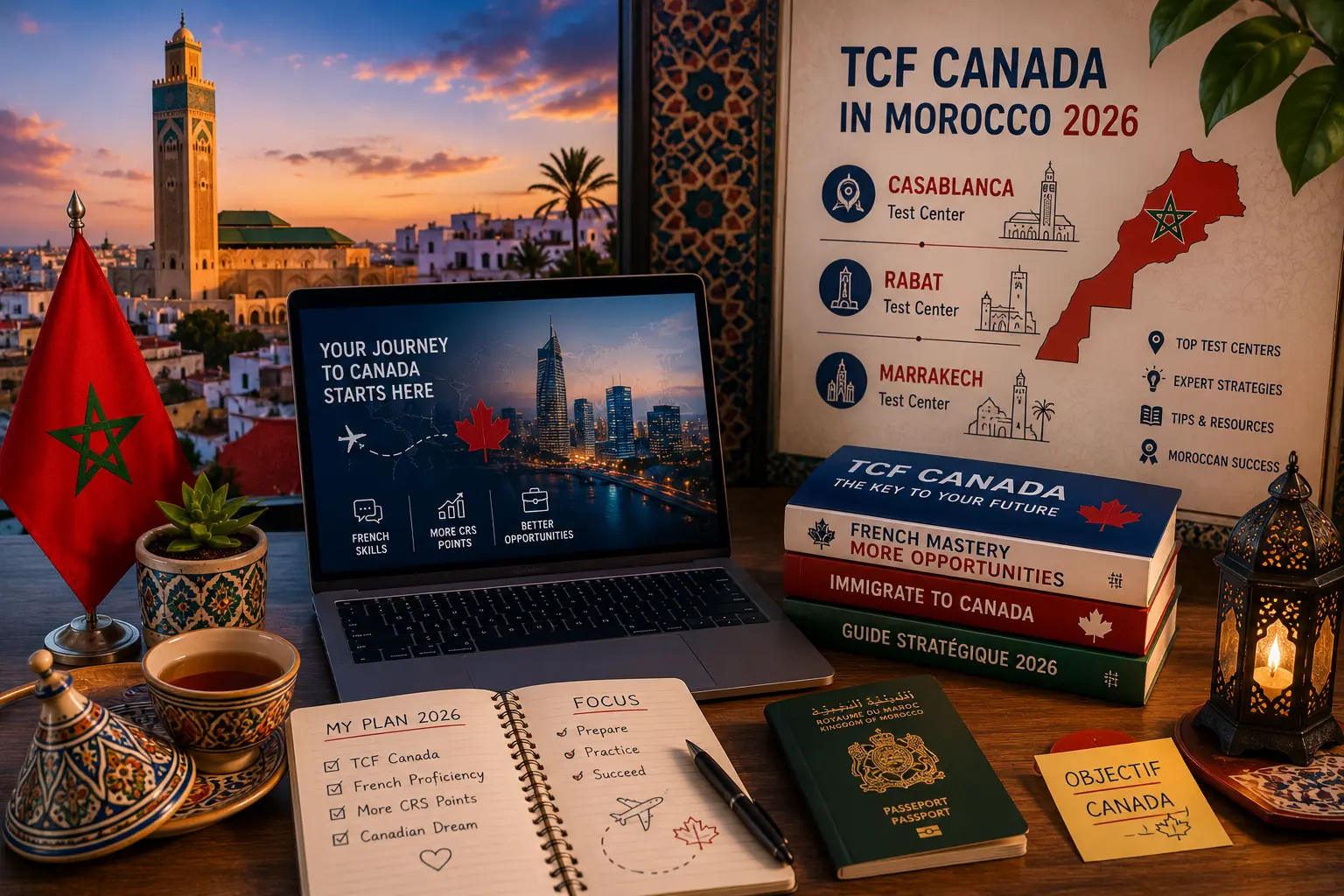
TCF Canada in Morocco 2026: Casablanca, Rabat and Marrakech Test Centers — The Complete Strategic Guide for Moroccan Candidates
Morocco consistently ranks among the top five source countries for francophone immigration to Canada. With over 120,000 Moroccan-Canadians already established across Montreal, Ottawa, Toronto and beyond, and with a steady flow of engineers, doctors, accountants and IT professionals seeking the Canadian pathway, the TCF Canada has become a rite of passage for an entire generation of ambitious Moroccans. This comprehensive 2026 guide is designed specifically for the Moroccan candidate — from registration logistics in Casablanca to the linguistic nuances that determine whether you reach NCLC 8 or stay at NCLC 6.
TCF Canada Test Centers in Morocco: Complete 2026 Directory
Morocco has one of the densest networks of TCF Canada examination centers in Africa and the Arab world, making access relatively straightforward for most candidates regardless of their region.
| City | Center | Address | Session Frequency | Notes |
|---|---|---|---|---|
| Casablanca | Institut Français de Casablanca | 121 Boulevard Mohammed Zerktouni, Casa | 3–4 times/month | Highest frequency — primary recommendation |
| Rabat | Institut Français de Rabat | 1 Rue Abou Inane, Rabat | 2–3 times/month | Government professionals — well-organized sessions |
| Marrakech | Institut Français de Marrakech | Route de Targa, Marrakech | 1–2 times/month | Book 8 weeks ahead — high demand from south |
| Fès | Institut Français de Fès | 33 Route de Sefrou, Fès | Monthly | Candidates from northeast Morocco — Meknes, Oujda |
| Tanger | Institut Français de Tanger | 3 Rue Ibn Rochd, Tanger | Monthly | Also accessible for candidates near Tetouan |
| Agadir | Institut Français d'Agadir | Avenue Hassan II, Agadir | Quarterly | Southern candidates — limited frequency |
| Oujda | Institut Français d'Oujda | Oujda centre-ville | Quarterly | Eastern region — travel to Fès recommended for urgency |
Registration process and practical tips:
- Register via france-education-international.fr — create your account and select TCF Canada (not the standard TCF)
- Payment in Moroccan dirhams (MAD) — approximately 3,500–5,000 MAD for all 4 skills depending on center and year
- Book 6–8 weeks in advance for Casablanca and Rabat; 10 weeks for other cities
- Valid national passport mandatory on exam day — CIN accepted in some centers, but passport is universally safe
- Arrive 30 minutes before convocation time — latecomers are systematically excluded
The Moroccan Candidate's Linguistic Profile: Assets and Vulnerabilities
Morocco occupies a unique sociolinguistic position: it is simultaneously an Arabic-speaking country, a Tamazight-speaking country, and one of the world's most naturally francophone nations outside Europe. This complexity creates both genuine advantages and specific challenges for the TCF Canada.
Your Structural Advantages
Why Moroccan candidates are among the best-positioned in the world for TCF Canada:
- French-medium academic training: Sciences, engineering, medicine and law are taught in French at Moroccan universities — graduates arrive with a solid formal French register already in place
- Early French exposure: French is taught from Grade 3 (third year of primary school) as a compulsory subject — creating 15+ years of formal French study before university
- Professional French environment: Banking, industry, multinational companies and public administration in Morocco operate largely in French — a daily professional French register is already natural
- Established Canadian community: Morocco's large diaspora in Canada (120,000+) provides an active network for exam tips, immigration guidance and integration support
- Cultural familiarity with Quebec: French-Canadian media, music and culture are accessible and increasingly consumed in Morocco — useful for the Quebec accent challenge
Specific Challenges to Address in Preparation
Critical weak spots for Moroccan TCF Canada candidates:
- Moroccan Arabic interferences in spoken French (darija): Insertions like "yani" (c'est-à-dire), "kayna" (il y a), sentence structure calqued on Moroccan Arabic — must be completely eliminated from TCF Canada oral production
- The Quebec accent in listening: The most common surprise for Moroccan candidates trained in French-of-France phonology. Affricated "t" and "d" (ts, dz), diphthongs, Quebec-specific expressions — 5–6 weeks of daily Radio-Canada immersion is non-negotiable
- Register consistency under pressure: Many Moroccan candidates mix formal and informal French registers, especially in spontaneous speech. TCF Canada demands sustained formal register throughout all 4 skills
- Written gender agreement: Systematic errors on agreement of complex past participles and adjectives — a grammar checkpoint that distinguishes NCLC 7 from NCLC 9
- Oral recording without interaction: Moroccan professional culture values dialogue and feedback — speaking 2 minutes into a microphone without any interlocutor requires specific practice runs
The Moroccan Darija–French Interference: Correction Guide
This section addresses the most common language interference patterns unique to Moroccan French speakers, based on patterns observed across thousands of TCF Canada candidates from Morocco.
Most frequent Moroccan French interferences and corrections:
- Negation omission: "Je sais pas" → "Je ne sais pas" — the "ne" is systematically dropped in Moroccan spoken French but mandatory in TCF formal register
- Pronoun calque: "Il faut que je vais" → "Il faut que j'aille" (subjunctive) — the indicative substituting the subjunctive is a darija-influenced transfer
- Hybrid verbs: "Checker" (to check), "booker" (to book), "updater" (to update) — use "vérifier", "réserver", "mettre à jour"
- Number agreement errors: "Des informations importante" → "Des informations importantes" — plural agreement mandatory in written French
- False cognates (faux amis with Arabic): Using French words in their Moroccan Arabic usage rather than their standard French meaning — review a list of Franco-Moroccan semantic shifts before the exam
Preparation Programme: 10 Weeks from B2 to NCLC 9
| Week | Priority Focus | Daily Practice (90 min) | Weekly Milestone |
|---|---|---|---|
| 1 | Diagnostic + interference audit | Full mock test + personal error log construction | Top 15 recurring errors identified |
| 2–3 | Quebec accent immersion | 40 min OHdio + 30 min TCF listening exercises + 20 min Radio-Canada news | 70%+ comprehension of standard Quebec audio |
| 4 | Reading comprehension speed + strategy | 2 La Presse articles (active reading) + 20 TCF QCM timed | Speed reading 400 words/min, 85%+ accuracy |
| 5–6 | Written expression — all 3 tasks | 1 complete writing session/day (all 3 tasks in sequence) | All task types mastered, no darija interferences in writing |
| 7–8 | Oral expression — format mastery | 3 oral recordings/day + self-evaluation against NCLC criteria | Fluent structured 2-min arguments without hesitation fillers |
| 9 | Full integrated mock tests | 1 complete timed mock test (all 4 skills) per day | NCLC 8 achieved in all skills under timed conditions |
| 10 | Performance optimisation + logistics | Weak-skill targeted reinforcement + test-day protocol rehearsal | NCLC 9 target confirmed across at least 2 skills |
Moroccan Success Stories: Real Testimonials
"I graduated in civil engineering from EHTP Casablanca. My French academic base was solid but my oral spontaneous French was contaminated by darija influences. Three months of preparation focused on two things: Quebec accent immersion every morning (Radio-Canada before breakfast) and oral recording practice every evening. TCF Canada result: NCLC 9 in listening and reading, NCLC 8 in expression. CRS score: 479. Francophone draw ITA received in 4 months. Now engineering manager at a Montreal construction firm." — Youssef, 32, Civil Engineer, Montreal QC
"Doctor from Rabat. The challenge for me wasn't the language level — it was the TCF Canada format. I had never spoken into a recorder for 2 minutes alone. First practice session: disaster. By week 6, I had a 5-step structure I could deploy on any medical or social topic. NCLC 9 oral. NCLC 8 writing. I'm now completing my medical equivalency process in Quebec. The TCF Canada was the easiest part of the journey — if you prepare the format." — Dr. Sanaa, 39, Physician, Quebec City QC
CRS Simulation for Moroccan Profiles
CRS simulation — Moroccan engineer, age 33, no job offer:
- Age (33): 95 points
- Education (Master's / Ingénieur d'État): 135 points
- Foreign work experience (7 years): 72 points
- TCF Canada NCLC 9 (all 4 skills): 136 points ←
- Adaptability factors: 15 points
- Estimated CRS: ~453 — above francophone draw thresholds
For the complete CRS calculation guide and score simulator, read CRS Score Simulator for TCF Canada: Calculate Your Points. To understand how francophone draw thresholds compare to general Express Entry draws, read IRCC Category-Based Draws 2026. For the complete Moroccan-specific preparation guide in French, the sister article at La Préparation du TCF Canada au Maroc covers registration and local resources in detail. The TCF Canada vs TEF Canada strategic comparison is available at TCF Canada vs TEF Canada: The Definitive Comparison 2026.
Immigration Pathways Most Relevant for Moroccan Candidates
| Profile | Best Pathway | Min. NCLC | Moroccan Advantage |
|---|---|---|---|
| Engineer (civil, mechanical, IT) | FSWP Express Entry + Francophone draws | NCLC 7 | Ingénieur d'État recognized as Master's level by WES |
| Doctor / Pharmacist | Category draws (healthcare) + Quebec CRSSS | NCLC 8 | French-medium medical training — advantage in French clinical settings |
| Accountant / Finance | FSWP + Ontario PNP Human Capital | NCLC 7 | ISCAE and HEC Morocco graduates well-regarded |
| Teacher (French) | PNP Ontario / New Brunswick Francophone | NCLC 7 | Critical shortage — Moroccan French teachers actively recruited |
| Skilled trades | PNP provincial + AIPP Atlantic | NCLC 5–6 | Lower thresholds accessible for tradespeople |
For a complete breakdown of how TCF Canada language points interact with employment sector priorities, read TCF Canada and Priority Employment Sectors 2026. The diploma equivalency process — crucial for Moroccan engineering and medical graduates — is covered in full at TCF Canada and Diploma Equivalency 2026. For the 90-day action plan after your TCF Canada results, read After Your TCF Canada Results: The 90 Critical Days. The French-language resource Après les Résultats TCF Canada : Les 90 Jours Décisifs provides parallel guidance in French.
Resources Accessible from Morocco
Complete free preparation ecosystem from Morocco:
- Radio-Canada OHdio (app): Free Quebec French audio — essential for listening preparation. Works well on Moroccan mobile networks.
- TV5MONDE Maghreb (satellite): Widely available in Morocco — watch 30 minutes daily for French immersion including Canadian content
- La Presse+ (app): Montreal's major newspaper — excellent reading material matching TCF Canada register and Canadian themes
- BonPatron.com: Free French grammar checker — submit all your writing practice for instant correction
- tcfonline.com: Official FEI practice interface — the most authentic available simulation of real TCF Canada conditions
- Facebook groups "TCF Canada Maroc": Active Moroccan candidate communities sharing exam dates, tips and testimonials
- YouTube channels by Moroccan-Canadians: Multiple channels run by Moroccans who passed TCF Canada — practical insights on format and preparation
For the comprehensive free resource directory including tools accessible from North Africa, visit Preparing for TCF Canada on a Limited Budget 2026. The 90-day structured immersion programme specifically designed for candidates outside Canada is detailed at Building Your Canadian Francophone Immersion Bubble Abroad. In French, the equivalent resource at Créer votre Bulle d'Immersion Francophone Canadienne is tailored specifically for Moroccan and Maghrebi candidates.



 TCF Canada Hub
0 Comments
No comments
Be to the first to share your comment !