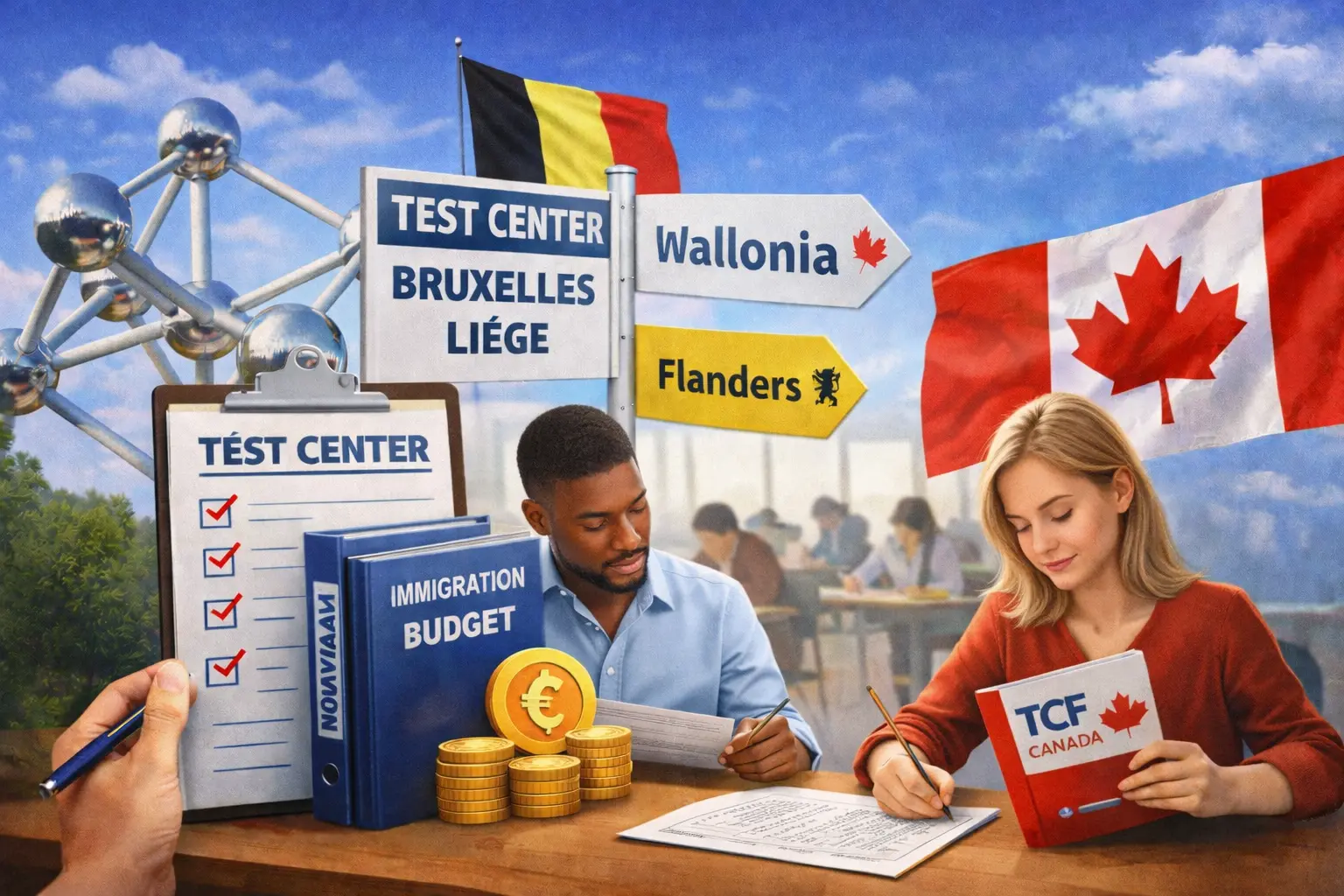
When Thomas, a 31-year-old Flemish web developer from Ghent, decided to immigrate to Canada via Express Entry in March 2026, he quickly realized the unique challenge for Belgian Dutch speakers: although Belgium is an officially trilingual country (French, Dutch, German), living in Flanders = 95% Dutch environment daily. "I had studied French in high school (6 years of classes), but my real level = B1 maximum (basic conversations). For TCF Canada NCLC 7-8, I had to follow intensive training for 14 months: Alliance Française Antwerp courses 3×/week (€1,800/year) + French-speaking Brussels weekend immersions + daily RTBF podcasts. Total preparation cost: €2,400 + 14 months time. Result: NCLC 7-7-7-8, CRS 398, ITA francophone draw October 2026 (threshold 365)," he recounts from Toronto where he now works at Shopify (salary $105,000 CAD vs €55,000 Ghent). Conversely, Marie, a 29-year-old Walloon lawyer from Liège, native French speaker, obtained NCLC 9-9-8-9 after only 5 weeks TCF format familiarization (total cost €480). This guide reveals contrasting realities for Belgian candidates by linguistic region, test center mapping, budget optimization strategies, and specifics of the numerous Belgian-African diaspora.
TCF Canada Test Centers Belgium 2026
Brussels (Bilingual Capital Region)
| Center | Session Frequency | Price | Particularities |
|---|---|---|---|
| Alliance Française Bruxelles-Europe | 4-6 sessions/month | €420 | Largest center in Belgium, easy booking |
| CLL (Centre de Langues) | 3-4 sessions/month | €430 | University center, Saturday sessions available |
Wallonia (French-Speaking Region)
| City | Center | Frequency | Price |
|---|---|---|---|
| Liège | Alliance Française Liège-Wallonie | 2 sessions/month | €420 |
| Namur | Centre Culturel Namur (occasional sessions) | 1 session/month | €420 |
| Charleroi | Via Brussels (no local center) | N/A | Brussels travel necessary (50 km) |
Flanders (Dutch-Speaking Region)
| City | Center | Frequency | Price |
|---|---|---|---|
| Antwerp | Alliance Française Antwerpen | 1-2 sessions/month | €420 |
| Ghent | Via Brussels/Antwerp | N/A | Travel necessary (60 km Brussels) |
| Leuven | Via Brussels | N/A | 25 km Brussels |
Official Resource: Alliance Française Belgium - TCF Centers
For understanding how TCF Canada fits into your overall immigration strategy, see: Canadian Immigration System and TCF Canada: Understanding Express Entry and Language Points.
Specifics for Belgian Candidates by Linguistic Region
Walloon Candidates (Native French Speakers)
Massive Advantages:
- French mother tongue = NCLC 9-10 accessible in 4-6 weeks format familiarization
- Rigorous Belgian francophone education system (grammar, literature) = excellent foundation
- Walloon accent accepted in TCF (no penalty vs French France accent)
Average Walloon TCF Canada Performance:
| Education Level | Average Score Without Preparation | After 4-6 Weeks |
|---|---|---|
| Secondary (Baccalaureate) | NCLC 7-8 | NCLC 8-9 |
| University (Bachelor+) | NCLC 8-9 | NCLC 9-10 |
Typical Walloon Preparation Plan:
- Weeks 1-2: Format familiarization (official FEI book, practice tests)
- Weeks 3-4: Listening comprehension training Quebec/African accents (Radio-Canada podcasts)
- Weeks 5-6: Formal written expression perfection + timed oral expression
Walloon Budget: TCF €420 + Book €40 = €460 total
For comprehensive preparation strategies optimized for native French speakers, see: Strategic TCF Canada Planning: The Proven 3-Month Method That Delivers Results.
Flemish Candidates (Dutch Speakers)
Specific Challenges:
- French = 2nd/3rd language (after Dutch, often English)
- Flemish school-level French = B1-B2 maximum (6-8 years secondary school courses)
- 100% Dutch daily environment = little natural French practice
Timeline for NCLC 7-8 from School-Level B1: 12-18 months intensive training
Flemish Strategies:
- Intensive Courses: Alliance Française Antwerp/Brussels (3-4h/week, €1,500-2,000/year)
- Brussels Immersion: Weekends in French-speaking neighborhoods (Ixelles, Uccle), café conversations
- French-Speaking Roommate: Bilingual Brussels = possibility to live in daily French environment
- RTBF Media: Belgian francophone radio-television (familiar accent vs France)
Flemish Budget: TCF €420 + 14-month Training €2,400 + Brussels Travel €500 = €3,320 total
Brussels Candidates (FR-NL Bilingual)
Ideal Situation:
- Natural bilingual environment (60% French speakers in Brussels)
- Local test center access (no travel)
- French level generally NCLC 8-9 without effort
Advanced Preparation Strategies by Profile
Intensive French Training Options for Flemish Candidates
Flemish candidates face a unique situation: they need to elevate French from school-learned second language to immigration-qualifying proficiency. Here are proven pathways:
| Strategy | Duration | Cost | Expected Outcome |
|---|---|---|---|
| Alliance Française Part-Time | 12-18 months | €1,500-2,000/year | B1 → NCLC 7-8 |
| Full-Time Immersion (Brussels) | 6-9 months | €3,500-5,000 + living costs | B1 → NCLC 8-9 |
| Self-Study + Private Tutoring | 10-14 months | €1,200-1,800 | B1 → NCLC 7 |
| Hybrid (Online + Weekend Brussels) | 12-15 months | €1,800-2,500 | B1 → NCLC 7-8 |
Recommended Path for Working Flemish Professionals:
- Month 1-3: Online intensive courses (Babbel, iTalki private tutors) - 5h/week - €300
- Month 4-9: Alliance Française Antwerp evening classes - 3h/week - €1,200
- Month 10-12: Brussels weekend immersion - every other weekend - €400
- Month 13-14: TCF-specific preparation - online materials + practice tests - €100
- Month 15: Take TCF Canada - €420
Total Investment: €2,420 over 15 months for NCLC 7-8 target
Walloon Candidates: Maximizing Native Advantage
Walloon candidates often underestimate preparation needs, assuming native French automatically guarantees high scores. Reality: TCF Canada tests specific competencies requiring targeted preparation even for natives.
Common Walloon Mistakes to Avoid:
- Underestimating Listening Comprehension: Quebec and African French accents differ significantly from Belgian French - practice essential
- Informal Writing Habits: Daily French writing (texts, social media) uses informal register - TCF requires formal academic style
- Unprepared Oral Expression: Spontaneous conversation ≠ structured 12-minute monologue with clear introduction/development/conclusion
- Timing Management: Native speakers often run out of time assuming they can improvise - timed practice critical
Optimized 4-Week Walloon Preparation:
- Week 1: Take full practice test to identify weaknesses (usually oral/written expression)
- Week 2: Daily 30-minute listening to Radio-Canada podcasts (accent familiarization)
- Week 3: Write 3 formal essays using TCF structures, get corrections from teacher/tutor
- Week 4: Record 5 oral expression responses, self-critique timing and structure
For specific techniques to maximize scores even as native speaker, see: Complete TCF Canada Ultimate Guide 2026.
Belgian-African Dual Nationality (Common Case)
African Diaspora in Belgium:
- Belgian-Congolese: 80,000+ (DRC = former Belgian colony)
- Belgian-Rwandan: 30,000+
- Belgian-Burundian: 15,000+
Strategic Dual Nationality Advantage:
| Aspect | Declare Belgian Nationality | Declare African Nationality |
|---|---|---|
| Credential Recognition | Excellent (European system) | Variable (by country/university) |
| Police Certificate | Easy (online, 2 weeks) | Complex (6-12 weeks from Africa) |
| Travel Passport | Visa-free Canada tourism | Visa often required |
Recommendation: Declare Belgian nationality = optimal in 95% of cases (except specific PNP programs targeting francophone Africans)
Belgian Credential Equivalency in Canada
| Belgian Credential | Canadian Equivalency (WES) | CRS Points |
|---|---|---|
| CESS (Certificate of Higher Secondary Education) | Secondary School Diploma | 28 pts max |
| Bachelier (Bac+3) | Bachelor's Degree (3 years) | 112 pts |
| Master (Bac+5) | Master's Degree | 126 pts |
| Doctorate | Doctorate (PhD) | 140 pts |
Belgian Universities with International Prestige:
- KU Leuven (Top 50 globally) = excellent recognition
- UCLouvain, ULB (Free University of Brussels), ULiège = good recognition
ECA Process: WES $267 CAD (≈€180), timeline 4-6 weeks
For complete guidance on credential recognition process, see: TCF Canada and Credential Equivalency 2026: Complete Guide to Getting Your Qualifications Recognized in Canada.
Complete Canadian Immigration Budget (Belgian Candidate)
Typical Walloon Candidate (Native French Speaker)
| Item | Cost EUR |
|---|---|
| TCF Canada | €420 |
| Preparation (book) | €40 |
| Credential ECA | €180 |
| Police Certificate | €0 (free Belgium) |
| IRCC Fees (PR) | €1,150 |
| Medical Exam | €250-300 |
| TOTAL | €2,040-2,090 |
Typical Flemish Candidate (Training Required)
| Item | Cost EUR |
|---|---|
| TCF Canada | €420 |
| French Training 14 months | €2,400 |
| Travel/Immersion | €500 |
| ECA + IRCC + Medical | €1,580 |
| TOTAL | €4,900 |
Cost-Benefit Analysis: Francophone vs Anglophone Immigration Path
For Flemish Candidates: Is French Worth the Investment?
Flemish candidates often wonder: with already good English (B2-C1 typical), why invest in French? Here's the mathematical answer:
| Factor | Anglophone Path | Francophone Path | Advantage |
|---|---|---|---|
| CRS Threshold (2026 avg) | 485-510 points | 360-390 points | Francophone: -120 pts needed |
| Language Test Investment | €350 (IELTS prep) | €3,320 (French training + TCF) | Anglophone: -€2,970 |
| Time to ITA | 12-36 months (if CRS sufficient) | 6-12 months (francophone draws) | Francophone: -6-24 months |
| Draw Frequency | Bi-weekly (highly competitive) | Monthly dedicated francophone | Francophone: guaranteed pathway |
Verdict for Flemish Candidates:
If your current CRS score (with English) is 450-480: Anglophone path viable, French not essential.
If your current CRS score is 380-450: French investment = guaranteed ITA pathway (€3,000 investment buys certainty vs years of waiting).
If your current CRS score is <380: French becomes mandatory for realistic immigration chance.
Example - Thomas's Case Study:
- Profile: 31 years old, Bachelor in IT, 5 years experience, single
- CRS with English only (IELTS 7.5): 398 points
- CRS with French (NCLC 7-7-7-8): 398 + 50 (bilingualism bonus) = 448 points
- Result: October 2026 francophone draw threshold = 365 points (he qualifies with 448)
- Investment: €3,320 over 14 months = guaranteed Canadian PR
For calculating your own CRS score and determining optimal language strategy, see: How to Calculate Your TCF Canada Points for Immigration.
Settlement Advantages for Belgian Immigrants in Canada
Belgian Community in Canada
Belgian Population Distribution:
- Ontario (Toronto, Ottawa): 35,000+ Belgian-Canadians
- Quebec (Montreal): 28,000+
- British Columbia (Vancouver): 12,000+
- Alberta (Calgary): 8,000+
Belgian Professional Recognition Success Rates:
Belgian credentials (especially from KU Leuven, UCLouvain, ULB) are highly regarded in Canada. Success rates for professional licensing:
- Engineers: 85-90% obtain P.Eng. within 18-24 months (higher than global average 65%)
- IT Professionals: Immediate employment (non-regulated sector)
- Nurses: 75-80% obtain RN license within 12-18 months
- Teachers: 70-75% obtain teaching certificate within 12 months
Average Belgian Immigrant Outcomes (2024-2025 data):
- Employment within 6 months: 82% (Canadian average: 68%)
- Median salary first job: $58,000 CAD (Canadian immigrant average: $48,000)
- Working in trained field within 2 years: 76% (average: 61%)
For understanding settlement costs and quality of life across Canadian regions, see: Cost of Living in Francophone Canadian Provinces 2026: Complete Guide to Planning Your Settlement Budget.
Belgium Resources
Conclusion: Belgian Pathways to Canadian Immigration
Belgium presents a unique duality: Walloon/Brussels francophones possess massive advantages (NCLC 9-10 easily achievable, €2,000 budget), while Flemish candidates must invest time (12-18 months) and money (€5,000) in French training. BUT even for Flemish candidates, the francophone strategy remains viable: Thomas (Ghent) invested 14 months + €4,900 = result CRS 398 (vs 485+ needed for anglophone draws) = net gain -87 CRS points required. Your linguistic region in Belgium determines strategy, but the objective remains accessible to all.
The mathematics are clear: for Walloons, Canadian francophone immigration is a streamlined pathway requiring minimal investment. For Flemish candidates, the decision requires analysis: if your English-only CRS is already competitive (480+), anglophone route works. If you're in the 380-450 range, investing €3,000-5,000 in French training buys you a guaranteed pathway through monthly francophone draws with thresholds 120+ points lower than general draws.
Your Belgian Action Plan:
- Step 1: Calculate your current CRS score (use official IRCC calculator)
- Step 2 (Walloons): Book TCF Canada in Brussels/Liège, prepare 4-6 weeks, expect NCLC 9-10
- Step 2 (Flemish): Assess current French level (A2/B1 typical), plan 12-15 month training pathway
- Step 3: Order credential ECA from WES (parallel to language preparation)
- Step 4: Take TCF Canada when ready, await results (7-10 days digital format)
- Step 5: Create Express Entry profile, enter francophone draw pool
- Step 6: Receive ITA (typically within 3-6 months for qualified francophone candidates)
- Step 7: Submit PR application, await processing (6-10 months)
- Step 8: Land in Canada as permanent resident 🇧🇪🇨🇦
Belgium's multilingual character, high-quality education system, and strong credential recognition in Canada position Belgian candidates for immigration success. Whether you're a Walloon francophone or a Flemish Dutch speaker willing to invest in French proficiency, the Canadian pathway is clear and achievable. Your starting point differs, but the destination is the same: permanent residence in one of the world's most welcoming, prosperous, and francophone-friendly countries.
For additional perspectives and success stories from Belgian immigrants, see: Inspiring Testimonials: How They Succeeded in Their TCF Canada.


 TCF Canada Hub
0 Comments
No comments
Be to the first to share your comment !